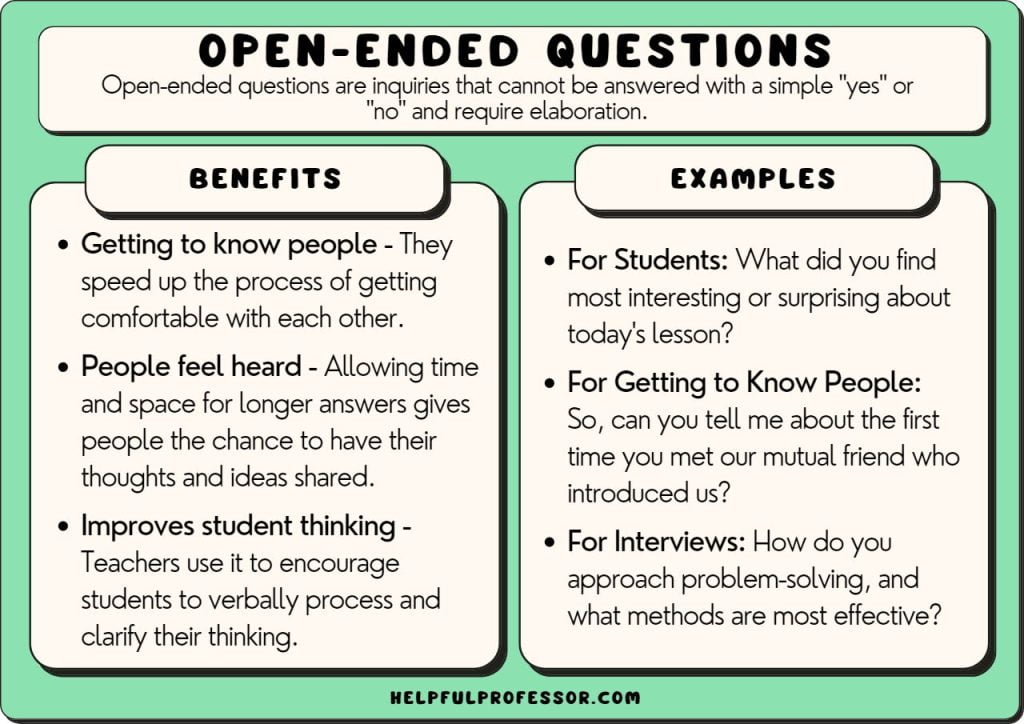
Elaboration questions are a powerful tool in the realm of inquiry-based learning. These thought-provoking questions encourage students to think deeply, analyze information, and develop a deeper understanding of the subject matter. By challenging students to elaborate on their thoughts, elaboration questions foster critical thinking skills and promote active engagement in the learning process.
When students are presented with elaboration questions, they are encouraged to expand on their initial responses, provide evidence to support their ideas, and make connections between different concepts. This process of elaboration not only enhances students’ comprehension but also promotes higher-order thinking skills such as analysis, synthesis, and evaluation. Elaboration questions can be used in various educational settings, from classrooms to online learning platforms, to stimulate intellectual curiosity and foster a deeper understanding of the subject matter.
Moreover, elaboration questions play a crucial role in facilitating meaningful discussions and promoting collaboration among students. By encouraging students to elaborate on their ideas, these questions create an environment where students can actively listen to each other, consider different perspectives, and engage in constructive dialogue. This collaborative approach not only deepens students’ understanding but also helps develop their communication and interpersonal skills, which are essential for success in the real world.
See these elaboration questions:
- How does this concept relate to what we learned previously?
- Can you provide an example to illustrate your point?
- What evidence supports your claim?
- Why do you think this is the case?
- What are the potential consequences of this phenomenon?
- How does this information challenge your previous beliefs?
- What other factors could have influenced the outcome?
- Can you explain the process step by step?
- What are the underlying assumptions in this argument?
- How does this relate to real-life situations?
- What are the implications of this research?
- What are the potential limitations of this approach?
- Can you compare and contrast these two theories?
- What are the ethical considerations in this scenario?
- How does this information align with your personal experiences?
- What are the different perspectives on this issue?
- Can you predict the possible outcomes of this experiment?
- How does this concept apply to different cultures?
- What are the long-term effects of this decision?
- Can you propose alternative solutions to this problem?
- What are the potential implications of ignoring this issue?
- How does this connect to the broader societal context?
- What are the counterarguments to this claim?
- Can you identify any patterns or trends in the data?
- What are the practical applications of this theory?
- How does this information challenge the existing literature?
- What are the potential biases in this study?
- Can you identify any logical fallacies in this argument?
- What are the key factors contributing to this problem?
- How does this concept relate to current events?
- What are the potential implications of this policy?
- Can you evaluate the reliability of this source?
- What are the possible solutions to this ethical dilemma?
- How does this information align with the scientific consensus?
- What are the cultural differences in attitudes towards this topic?
- Can you identify any confounding variables in this study?
- What are the implications of this discovery for future research?
- How does this theory challenge the existing paradigm?
- What are the potential societal impacts of this technological advancement?
- Can you identify any logical inconsistencies in this argument?
- What are the economic implications of this policy decision?
- How does this concept relate to the principles of social justice?
- What are the potential environmental consequences of this action?
These are just a few examples of elaboration questions that can be used to stimulate critical thinking and engage students in meaningful discussions. By incorporating elaboration questions into your teaching practice, you can empower students to think deeply, explore complex ideas, and develop a deeper understanding of the subject matter.