
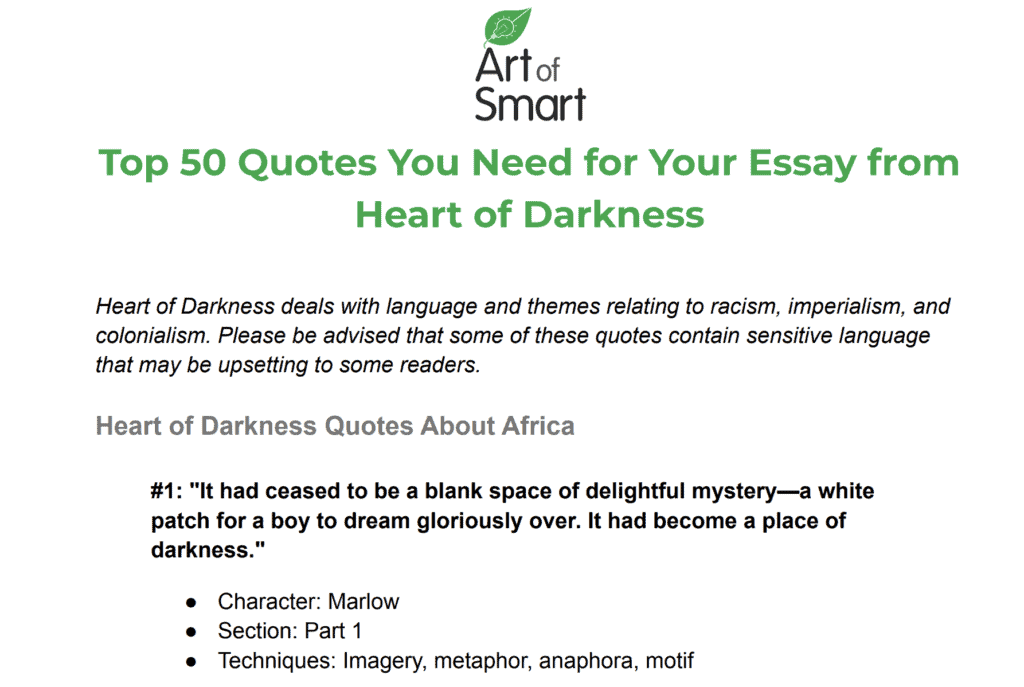
Joseph Conrad’s novel, “Heart of Darkness,” is a powerful exploration of the human psyche and the darkness that lies within. Set in the heart of Africa during the height of European imperialism, the novel delves into the themes of power, greed, and the destructive nature of colonization. Conrad’s use of vivid imagery and thought-provoking quotes provides readers with a deeper understanding of the impact of imperialism. In this article, we will examine some of the most poignant quotes from “Heart of Darkness” that shed light on the effects of imperialism.
Imperialism is a recurring theme throughout “Heart of Darkness.” Conrad skillfully portrays the destructive nature of colonization and its impact on both the colonizers and the colonized. The following quotes highlight the darkness that imperialism brings:
Read these Heart of Darkness Imperialism Quotes
“The conquest of the earth, which mostly means the taking it away from those who have a different complexion or slightly flatter noses than ourselves, is not a pretty thing when you look into it too much.”
“All Europe contributed to the making of Kurtz, and by-and-by I learned that, most appropriately, the International Society for the Suppression of Savage Customs had entrusted him with the making of a report, for its future guidance.”
“The word ‘ivory’ rang in the air, was whispered, was sighed. You would think they were praying to it. A taint of imbecile rapacity blew through it all, like a whiff from some corpse.”
“It was unearthly, and the men were—No, they were not inhuman. Well, you know, that was the worst of it—the suspicion of their not being inhuman. It would come slowly to one. They howled and leaped and spun and made horrid faces, but what thrilled you was just the thought of their humanity—like yours—the thought of your remote kinship with this wild and passionate uproar. Ugly. Yes, it was ugly enough, but if you were man enough you would admit to yourself that there was in you just the faintest trace of a response to the terrible frankness of that noise, a dim suspicion of there being a meaning in it which you—you so remote from the night of first ages—could comprehend.”
“I had not seen him approach, and the sudden appearance made me start. He was a slim young man, with an ascetic aspect, but he had the eyes of an enthusiast.”
“It was the stillness of an implacable force brooding over an inscrutable intention. It looked at you with a vengeful aspect.”
“He had summed up—he had judged. ‘The horror!’ He was a remarkable man. After all, this was the expression of some sort of belief; it had candor, it had conviction, it had a vibrating note of revolt in its whisper, it had the appalling face of a glimpsed truth—the strange commingling of desire and hate.”
“They were conquerors, and for that you want only brute force—nothing to boast of, when you have it, since your strength is just an accident arising from the weakness of others.”
“I had no idea why he wanted to be sociable, but as we chatted in there it suddenly occurred to me the fellow was trying to get at something—in fact, pumping me. He alluded constantly to Europe, to the people I was supposed to know there—putting leading questions as to my acquaintances in the sepulchral city, and so on.”
“The wilderness had patted him on the head, and, behold, it was like a ball—an ivory ball; it had caressed him, and—lo!—he had withered; it had taken him, loved him, embraced him, got into his veins, consumed his flesh, and sealed his soul to its own by the inconceivable ceremonies of some devilish initiation.”
“Your strength is just an accident arising from the weakness of others.”
“What thrilled you was just the thought of their humanity—like yours—the thought of your remote kinship with this wild and passionate uproar.”
“They howled and leaped and spun and made horrid faces, but if you were man enough you would admit to yourself that there was in you just the faintest trace of a response to the terrible frankness of that noise.”
“The conquest of the earth, which mostly means the taking it away from those who have a different complexion or slightly flatter noses than ourselves, is not a pretty thing when you look into it too much.”
“All Europe contributed to the making of Kurtz, and by-and-by I learned that, most appropriately, the International Society for the Suppression of Savage Customs had entrusted him with the making of a report, for its future guidance.”
“The word ‘ivory’ rang in the air, was whispered, was sighed. A taint of imbecile rapacity blew through it all, like a whiff from some corpse.”
“It was unearthly, and the men were—No, they were not inhuman. Well, you know, that was the worst of it—the suspicion of their not being inhuman. It would come slowly to one.”
“He was a slim young man, with an ascetic aspect, but he had the eyes of an enthusiast.”
“It was the stillness of an implacable force brooding over an inscrutable intention. It looked at you with a vengeful aspect.”
“He had summed up—he had judged. ‘The horror!’ He was a remarkable man.”
In conclusion, “Heart of Darkness” offers a profound critique of imperialism through its powerful quotes. Conrad’s portrayal of the darkness within imperialism serves as a stark reminder of the destructive nature of colonization. These quotes provide readers with a deeper understanding of the impact of imperialism and the human psyche. By examining the themes and quotes from “Heart of Darkness,” we can gain valuable insights into the consequences of power and greed.






