
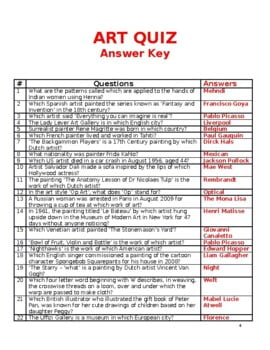
Art has always been a medium through which humans express their creativity, emotions, and thoughts. It has the power to move, inspire, and provoke deep contemplation. However, understanding art can sometimes be challenging, and many questions arise when we encounter different forms and styles. In this article, we aim to provide answers to some commonly asked art questions to enhance your knowledge and appreciation of this fascinating field.
See These Art Questions with Answers
Art can be defined as a diverse range of human activities involving the creation of visual, auditory, or performance-based works that express the creator’s imagination, ideas, or technical skills.
The title of the greatest artist of all time is subjective and varies based on personal preferences. Some renowned artists often mentioned in this context include Leonardo da Vinci, Michelangelo, Vincent van Gogh, and Pablo Picasso.
The purpose of art is multifaceted. It can be a form of self-expression, a means to communicate ideas, emotions, or cultural values, a tool for social or political commentary, or simply an aesthetic experience that brings joy and beauty to our lives.
Modern art refers to artistic works created between the 1860s and 1970s, while contemporary art refers to art created from the 1970s to the present day. Contemporary art reflects the current time and can encompass various styles and mediums.
The Mona Lisa, painted by Leonardo da Vinci, is one of the most famous artworks in the world. Its significance lies in its enigmatic smile, the mastery of technique, and the lasting impact it has had on the art world and popular culture.
Color plays a crucial role in art as it can convey emotions, create visual impact, and evoke specific reactions from viewers. Artists use color theory and combinations to enhance their artistic expression and communicate their intended message.
Art galleries and museums serve as spaces to exhibit and preserve artworks for public viewing and appreciation. They play a vital role in educating the public about art history, showcasing artistic achievements, and promoting cultural heritage.
Throughout history, numerous art movements have emerged, each with its own unique characteristics and philosophies. Some notable art movements include Renaissance, Baroque, Impressionism, Cubism, Surrealism, Abstract Expressionism, and Pop Art.
A sculpture refers to any three-dimensional artwork made by shaping or combining materials such as stone, metal, wood, or clay. A statue, on the other hand, specifically refers to a free-standing sculpture of a person or an animal.
Artists create perspective in their artwork by using techniques such as linear perspective, atmospheric perspective, and foreshortening. These techniques create an illusion of depth and space, making the artwork appear more realistic.
Art criticism involves analyzing and evaluating artworks based on various criteria such as aesthetics, technique, historical context, and cultural significance. Its purpose is to provide insights, interpretations, and judgments that contribute to the understanding and appreciation of art.
Abstract art does not attempt to represent an accurate depiction of visual reality. Instead, it focuses on the use of color, shape, line, and form to convey emotions, ideas, or concepts in a non-representational or non-objective manner.
Artists choose their subject matter based on personal interests, experiences, observations, or the desire to convey a particular message. They may draw inspiration from nature, human figures, historical events, social issues, or their own imagination.
A print is a reproduction of an artwork created through various printing techniques, while an original artwork is a one-of-a-kind piece created directly by the artist. Prints are often produced in multiples, while original artworks are unique and hold higher value.
The Sistine Chapel ceiling, painted by Michelangelo, is considered one of the greatest achievements in Western art. Its significance lies in its stunning frescoes depicting biblical scenes and the exceptional skill and creativity demonstrated by the artist.
Art therapy is a form of psychological therapy that utilizes art-making as a means of expression and healing. It can help individuals explore and process their emotions, improve self-esteem, and promote personal growth and well-being.
Fine art refers to art created primarily for aesthetic purposes, such as painting, sculpture, and drawing. Applied art, on the other hand, refers to art that serves a practical function, such as architecture, graphic design, fashion design, and industrial design.
The Guernica painting, created by Pablo Picasso, is a powerful anti-war artwork that depicts the suffering and chaos caused by the bombing of Guernica during the Spanish Civil War. It has become a symbol of the atrocities of war and a plea for peace.
Art education plays a crucial role in fostering creativity, critical thinking, and cultural awareness. It provides individuals with the opportunity to explore various art forms, develop artistic skills, and gain a deeper understanding and appreciation of art.
A landscape refers to a depiction of natural scenery, such as mountains, forests, or fields, while a seascape specifically portrays a coastal or oceanic scene. Both genres have been widely explored by artists throughout history.
The Last Supper, painted by Leonardo da Vinci, is a renowned religious artwork depicting the final meal of Jesus Christ with his disciples. Its significance lies in its portrayal of the emotional intensity and the narrative of one of the most significant events in Christianity.
Art plays a vital role in society by reflecting cultural values, challenging social norms, promoting dialogue and understanding, and providing aesthetic pleasure. It has the power to inspire change, unite communities, and shape our collective identity.
A portrait is a representation of a specific person, while a self-portrait is an artwork created by the artist, depicting themselves. Self-portraits allow artists to explore self-identity, introspection, and self-expression.
Performance art is a form of artistic expression that involves live actions or events performed by the artist. Its purpose is often to challenge traditional art forms and engage the audience in a unique and interactive experience.
The Starry Night, painted by Vincent van Gogh, is an iconic artwork famous for its swirling brushwork and vibrant colors. Its significance lies in its emotional intensity and the artist’s depiction of his own turbulent mental state.
Realism aims to depict subjects accurately and objectively, often focusing on everyday life and social issues. Impressionism, on the other hand, emphasizes capturing fleeting moments and the changing effects of light and color, often through loose brushwork.
Art auctions provide a platform for buying and selling artworks, often of significant value. They allow collectors, investors, and art enthusiasts to acquire unique or rare pieces, while also contributing to the valuation and recognition of artists.
The Venus de Milo is an ancient Greek sculpture depicting the goddess Aphrodite. Its significance lies in its beauty, craftsmanship, and the timeless representation of female beauty and grace.
Art plays a crucial role in cultural preservation by documenting and representing cultural traditions, practices, and historical events. It helps transmit cultural knowledge from one generation to another and preserves the identity and heritage of communities.
A still life is a genre of art that depicts inanimate objects, such as fruits, flowers, or household items. A vanitas is a specific type of still life that includes symbolic elements, often reminding viewers of the transience of life and the inevitability of death.
The Birth of Venus, painted by Sandro Botticelli, is a masterpiece of Renaissance art. Its significance lies in its portrayal of the goddess Venus emerging from the sea, symbolizing beauty, love, and the rebirth of classical ideals.
Art installations are immersive, site-specific artworks created to transform a space and engage the viewer’s senses and perception. They often challenge traditional notions of art and provide a unique and interactive experience.
The enigmatic smile of the Mona Lisa has intrigued viewers for centuries. Its significance lies in its ambiguity, inviting interpretation and speculation, and adding to the allure and mystique of the artwork.
Classical art refers to the art of ancient Greece and Rome, characterized by idealized figures, harmony, and balance. Contemporary art refers to art created in the present time, often reflecting the diverse and ever-changing aspects of society.
Art restoration involves the conservation and repair of artworks to ensure their preservation and longevity. It aims to stabilize and protect the artwork while respecting its original materials, techniques, and aesthetic integrity.
The Mona Lisa is a masterpiece of Renaissance art that has captivated audiences for centuries. Its significance lies in its technical excellence, the mysterious expression of the subject, and its enduring legacy as an icon of art history.
A mural refers to any large-scale artwork painted directly on a wall or ceiling, while a fresco is a specific mural technique where pigments are applied to wet plaster, creating a long-lasting bond between the paint and the wall.
Art in urban spaces, often referred to as public art, serves various purposes such as beautifying the environment, creating a sense of identity and pride, promoting social engagement, and stimulating dialogue and reflection among communities.
The Persistence of Memory, painted by Salvador Dalí, is an iconic surrealist artwork featuring melting clocks. Its significance lies in its exploration of the subconscious mind, the fluidity of time, and the dreamlike quality that characterizes much of Dalí’s work.
Art in advertising serves to capture attention, convey messages, and evoke emotions in order to promote products or services. It often employs visual aesthetics and creative techniques to engage and persuade the audience.
A drawing refers to a more finished and detailed artwork, often created with various art mediums such as graphite, charcoal, or ink. A sketch, on the other hand, is a quick, preliminary drawing used to capture ideas, compositions, or observations.
The Starry Night, painted by Vincent van Gogh, is an iconic artwork famous for its swirling brushwork and vibrant colors. Its significance lies in its emotional intensity and the artist’s depiction of his own turbulent mental state.
Art has long been used as a powerful tool for social activism, allowing artists to raise awareness, challenge injustices, and inspire change. It provides a platform for marginalized voices and encourages dialogue and reflection on pressing social issues.
A photograph captures a moment in time through the use of a camera and light-sensitive materials, while a painting is a handcrafted image created by an artist using various art mediums. Both mediums have distinct characteristics and artistic possibilities.
The Scream, painted by Edvard Munch, is an iconic artwork that portrays existential angst and the human condition. Its significance lies in its emotional intensity, the powerful depiction of inner turmoil, and its universal resonance.
Art plays a crucial role in religious rituals by providing visual representations of sacred figures, stories, and concepts. It enhances the spiritual experience, facilitates worship, and serves as a means of communication between the divine and the human.
A gallery is a commercial space that exhibits and sells artworks, often representing specific artists or art styles. An art museum, on the other hand, is a nonprofit institution that collects, preserves, and exhibits artworks for educational and cultural purposes.
The Girl with a Pearl Earring, painted by Johannes Vermeer, is a renowned artwork famous for the enigmatic gaze of the subject and the luminous pearl. Its significance lies in its technical mastery, the subtle portrayal of emotions, and its enduring appeal.
Art competitions provide artists with a platform to showcase their skills, gain recognition, and receive feedback from experts in the field. They can also serve as a source of inspiration and motivation for artists to push their boundaries and excel in their craft.
The Creation of Adam, painted by Michelangelo on the ceiling of the Sistine Chapel, is a renowned artwork depicting the biblical creation of Adam, the first man. Its significance lies in its grandeur, the masterful technique, and the portrayal of the divine-human connection.
Art can serve as a therapeutic tool for emotional healing and self-expression. Through art-making, individuals can explore and process their emotions, gain insights into their experiences, and find solace and healing in the creative process.
A sculpture refers to a three-dimensional artwork created by shaping or combining materials, while an installation is a larger-scale artwork that often transforms a space or environment and involves various elements such as objects, sound, and light.
The Night Watch, painted by Rembrandt, is a renowned artwork featuring a group portrait of a Dutch militia. Its significance lies in its innovative composition, the portrayal of dynamic action, and its status as a masterpiece of Baroque art.
Art has long been used as a powerful medium for storytelling, allowing artists to convey narratives, evoke emotions, and engage viewers in a visual and imaginative experience. It can communicate complex ideas and perspectives in a universal and accessible way.
The Birth of Venus, painted by Sandro Botticelli, is a masterpiece of Renaissance art. Its significance lies in its portrayal of the goddess Venus emerging from the sea, symbolizing beauty, love, and the rebirth of classical ideals.
These art questions with answers provide a glimpse into the vast and fascinating world of art. Whether you are a seasoned art enthusiast or just beginning your artistic journey, exploring these questions can deepen your understanding and appreciation of this timeless form of expression. Art invites us to see the world through new perspectives, challenging our assumptions and expanding our horizons. So, embrace curiosity, keep asking questions, and let art inspire your imagination.






