
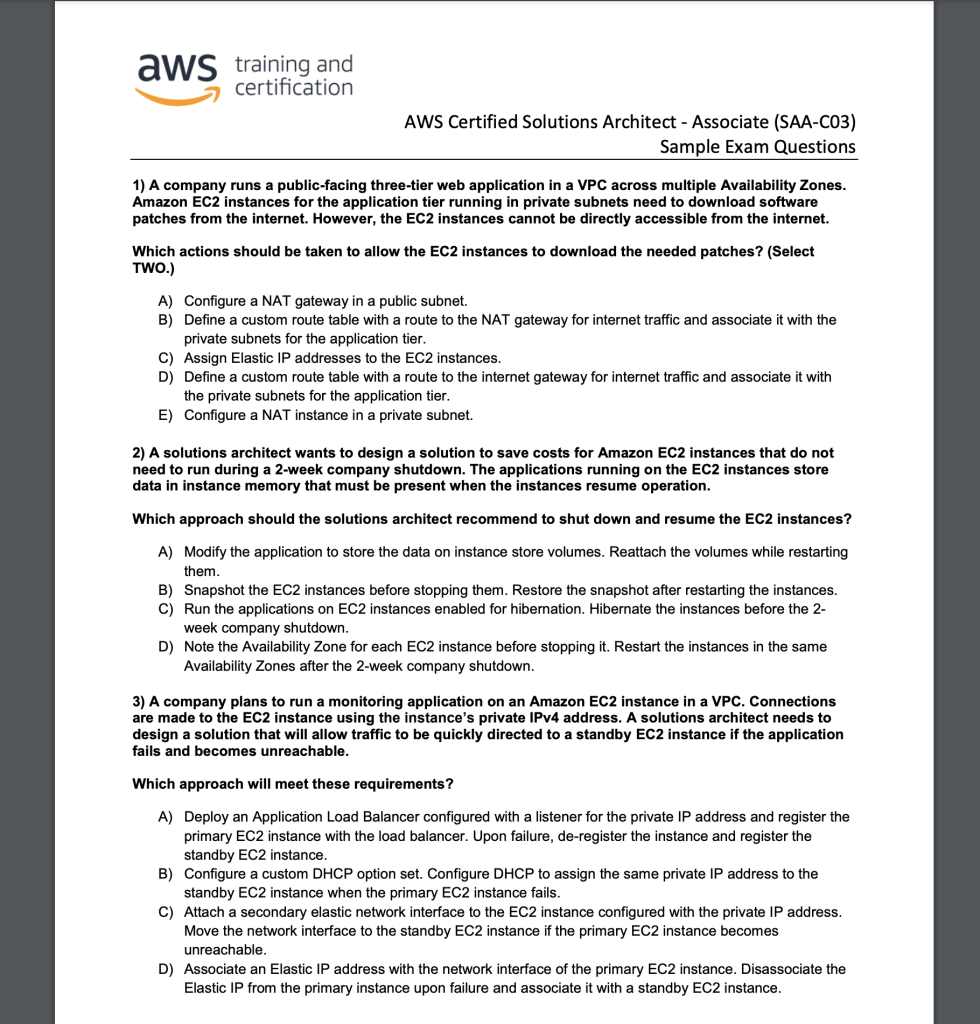
Are you preparing for the AWS Solutions Architect-Associate exam? This certification is highly sought after in the IT industry, as it validates your expertise in designing and deploying scalable, reliable, and cost-effective systems on the AWS platform. To help you in your preparation, we have compiled a list of exam questions that will familiarize you with the type of questions you can expect in the actual exam.
Before we dive into the questions, it’s important to note that the AWS Solutions Architect-Associate exam is a multiple-choice exam that consists of 65 questions. You will have 130 minutes to complete the exam, and you must score at least 720 out of 1000 to pass. The exam covers a wide range of topics, including designing highly available and fault-tolerant systems, selecting appropriate AWS services based on requirements, and estimating costs.
Now, let’s take a look at some sample AWS Solutions Architect-Associate exam questions:
See these AWS Solutions Architect-Associate Exam Questions
- What is the maximum number of VPCs that you can have per AWS region?
- Which AWS service provides a scalable and fully managed database solution?
- What is the purpose of an Elastic Load Balancer in AWS?
- Which AWS service can be used to store and retrieve large amounts of data?
- What is the difference between Amazon S3 and Amazon EBS?
- How can you secure communication between EC2 instances in a VPC?
- What is the purpose of Amazon CloudFront?
- What is the AWS service that provides automated code deployments?
- How can you monitor the performance and health of your AWS resources?
- What is the difference between on-demand and spot instances in EC2?
- How can you ensure data durability in Amazon S3?
- What is the purpose of an AWS CloudFormation template?
- Which AWS service can be used to analyze log data in real-time?
- What is the maximum size of an Amazon RDS database?
- How can you encrypt data at rest in an S3 bucket?
- What is the purpose of an Amazon VPC?
- Which AWS service can be used to run Docker containers?
- How can you automate the creation of AWS resources?
- What is the difference between Amazon RDS and Amazon DynamoDB?
- What is the purpose of an Amazon CloudWatch alarm?
- Which AWS service can be used to send notifications to subscribers?
- How can you ensure high availability in an AWS architecture?
- What is the AWS service that provides a managed message queue?
- How can you monitor API calls in AWS?
- What is the purpose of an AWS Identity and Access Management (IAM) role?
- Which AWS service can be used to perform data analysis?
- How can you automate the deployment of AWS resources?
- What is the difference between Amazon S3 and Amazon Glacier?
- What is the purpose of an Amazon Elastic Block Store (EBS) volume?
- Which AWS service can be used to create a virtual private network (VPN) connection?
- How can you monitor the performance of your AWS Lambda functions?
- What is the maximum number of subnets that you can have per VPC?
- What is the purpose of an Amazon Simple Notification Service (SNS) topic?
- Which AWS service can be used to perform real-time analytics on streaming data?
- How can you automate the deployment of your application code in AWS?
- What is the difference between Amazon EC2 and Amazon ECS?
- What is the purpose of an AWS CloudTrail?
- Which AWS service can be used to manage and deploy serverless applications?
- How can you monitor the performance and availability of your AWS resources?
- What is the maximum duration of an AWS Lambda function?
- What is the purpose of an Amazon Virtual Private Cloud (VPC) endpoint?
- Which AWS service can be used to create a data warehouse?
- How can you automate the scaling of your AWS resources?
We hope that these sample exam questions have provided you with a better understanding of the type of questions you can expect in the AWS Solutions Architect-Associate exam. Remember to thoroughly study the AWS documentation and practice with hands-on labs to increase your chances of passing the exam.






