
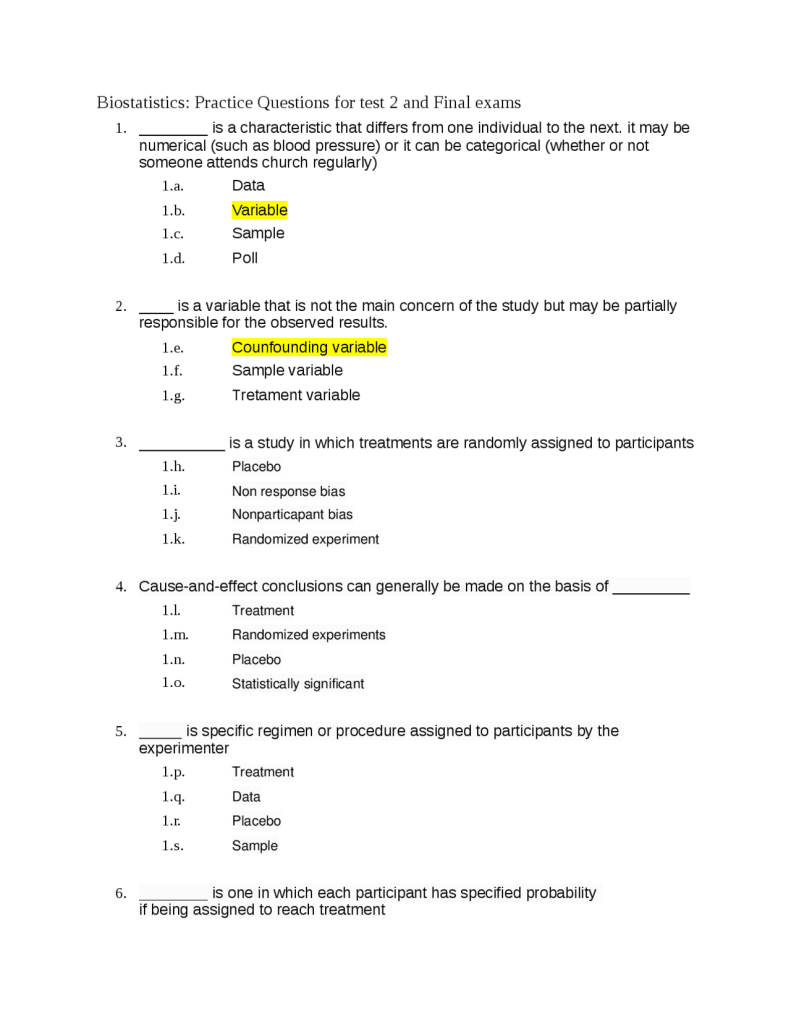
Biostatistics is a branch of statistics that focuses on the analysis and interpretation of data in the field of biology and health sciences. It plays a crucial role in conducting research studies, clinical trials, and making evidence-based decisions in healthcare. Whether you are a student preparing for a biostatistics exam or a researcher looking to sharpen your statistical skills, practicing with biostatistics questions is essential to enhance your understanding and proficiency in this field.
In this article, we have compiled a comprehensive list of biostatistics practice questions that cover various topics and concepts. These questions are designed to test your knowledge and problem-solving abilities in biostatistics. By attempting these practice questions, you can identify areas of strength and weakness, and focus on improving your skills in specific areas.
So, let’s dive into the world of biostatistics and challenge ourselves with these practice questions to enhance our understanding of statistical analysis in the context of biology and health sciences.
See these Biostatistics Practice Questions
- What is the difference between descriptive and inferential statistics?
- What are the measures of central tendency and how are they calculated?
- Explain the concept of probability and its applications in biostatistics.
- What is a p-value and how is it interpreted in hypothesis testing?
- Describe the steps involved in designing a randomized controlled trial.
- What is the purpose of sampling in biostatistics?
- What are the different types of sampling techniques?
- What is the difference between a population and a sample?
- How is a confidence interval calculated?
- What is the difference between a Type I and Type II error?
- Explain the concept of power in statistical analysis.
- What is the purpose of correlation analysis in biostatistics?
- How is a correlation coefficient calculated?
- What is the difference between a positive and negative correlation?
- Explain the concept of regression analysis and its applications in biostatistics.
- What is the difference between simple and multiple regression?
- Describe the assumptions of linear regression.
- How is the coefficient of determination interpreted?
- What is survival analysis and how is it used in biostatistics?
- Explain the concept of hazard ratio.
- What is the purpose of Kaplan-Meier analysis?
- How is the log-rank test used in survival analysis?
- What is the difference between a cross-sectional and longitudinal study?
- Describe the steps involved in analyzing categorical data.
- Explain the concept of odds ratio.
- What is the purpose of chi-square test in biostatistics?
- How is a contingency table analyzed?
- What is the difference between sensitivity and specificity?
- Describe the concept of area under the curve (AUC) in diagnostic tests.
- Explain the concept of receiver operating characteristic (ROC) curve.
- What is the purpose of meta-analysis in biostatistics?
- How are effect sizes calculated in meta-analysis?
- What is the difference between fixed-effects and random-effects models?
- Describe the steps involved in conducting a systematic review.
- Explain the concept of publication bias.
- What is the purpose of sensitivity analysis in meta-analysis?
- How is heterogeneity assessed in meta-analysis?
- What is the difference between a null hypothesis and an alternative hypothesis?
- Explain the concept of one-sample t-test.
- What is the purpose of analysis of variance (ANOVA) in biostatistics?
- How is a factorial design analyzed?
These are just a few examples of the biostatistics practice questions that you can explore to enhance your understanding of statistical analysis in the field of biology and health sciences. By regularly practicing and challenging yourself with these questions, you can strengthen your skills and become proficient in applying statistical methodologies to real-world scenarios.






