
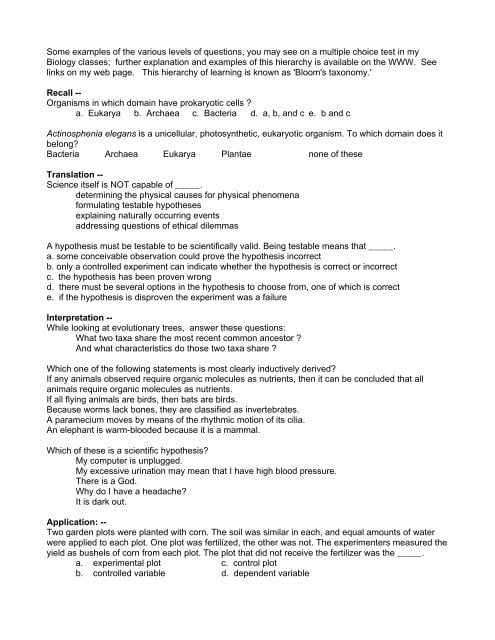
When it comes to evaluating the level of understanding and knowledge of students, teachers often rely on Bloom’s Taxonomy. Developed by Benjamin Bloom in the 1950s, this classification system categorizes cognitive skills into six levels: remembering, understanding, applying, analyzing, evaluating, and creating. By using Bloom’s Taxonomy test questions, educators can assess students’ critical thinking abilities and gauge their level of mastery in a particular subject.
Creating effective Bloom Taxonomy test questions requires careful consideration of each level of the taxonomy. The questions should be designed to challenge students and encourage them to think critically. By incorporating Bloom’s Taxonomy into assessment strategies, teachers can ensure that students are not only memorizing information but also able to apply it in real-world scenarios.
In this article, we have compiled a list of Bloom Taxonomy test questions that cover various subjects and levels of cognitive skills. These questions can be used by educators to assess students’ understanding and promote higher-order thinking skills.
See these Bloom Taxonomy test questions:
- Remembering: What are the three primary colors?
- Understanding: Explain the concept of supply and demand.
- Applying: How would you use the Pythagorean theorem to find the length of the hypotenuse in a right-angled triangle?
- Analyzing: Compare and contrast the themes in two different Shakespeare plays.
- Evaluating: Assess the effectiveness of a marketing campaign for a new product.
- Creating: Design a blueprint for an eco-friendly house.
- Remembering: Name the capital cities of five European countries.
- Understanding: Summarize the main events in a historical timeline.
- Applying: Solve a quadratic equation.
- Analyzing: Analyze the causes and consequences of the American Revolution.
- Evaluating: Evaluate the ethical implications of cloning.
- Creating: Write a short story using the elements of suspense.
- Remembering: What is the chemical formula of water?
- Understanding: Explain the process of photosynthesis.
- Applying: Calculate the area of a triangle.
- Analyzing: Analyze the symbolism in a poem by Robert Frost.
- Evaluating: Evaluate the effectiveness of a persuasive essay.
- Creating: Create a model of a solar system.
- Remembering: Who wrote the novel “To Kill a Mockingbird”?
- Understanding: Describe the concept of inertia.
- Applying: Apply the principles of statistics to analyze survey data.
- Analyzing: Analyze the impact of globalization on the economy.
- Evaluating: Evaluate the credibility of a scientific research paper.
- Creating: Develop a business plan for a new startup.
- Remembering: What are the seven continents?
- Understanding: Explain the concept of osmosis.
- Applying: Use the concept of slope to solve a real-life problem.
- Analyzing: Analyze the motives of a character in a novel.
- Evaluating: Evaluate the effectiveness of a historical documentary.
- Creating: Design a website for a local business.
- Remembering: What is the formula for calculating speed?
- Understanding: Describe the process of cell division.
- Applying: Apply the principles of geometry to solve a problem.
- Analyzing: Analyze the causes and effects of climate change.
- Evaluating: Evaluate the validity of a scientific hypothesis.
- Creating: Create a piece of artwork using mixed media.
- Remembering: Name the planets in the solar system.
- Understanding: Explain the concept of natural selection.
- Applying: Use the principles of algebra to solve an equation.
- Analyzing: Analyze the impact of social media on society.
- Evaluating: Evaluate the effectiveness of a political speech.
- Creating: Write a script for a short film.
These Bloom Taxonomy test questions are just a starting point for educators looking to assess students’ cognitive skills. By adapting and expanding upon these questions, teachers can create a comprehensive assessment that challenges students and encourages critical thinking.
Remember, Bloom’s Taxonomy is not only a tool for assessment but also a framework for designing effective lesson plans and promoting higher-order thinking in the classroom. By incorporating Bloom’s Taxonomy into teaching and assessment strategies, educators can ensure that students are developing the skills necessary for success in the 21st century.






