
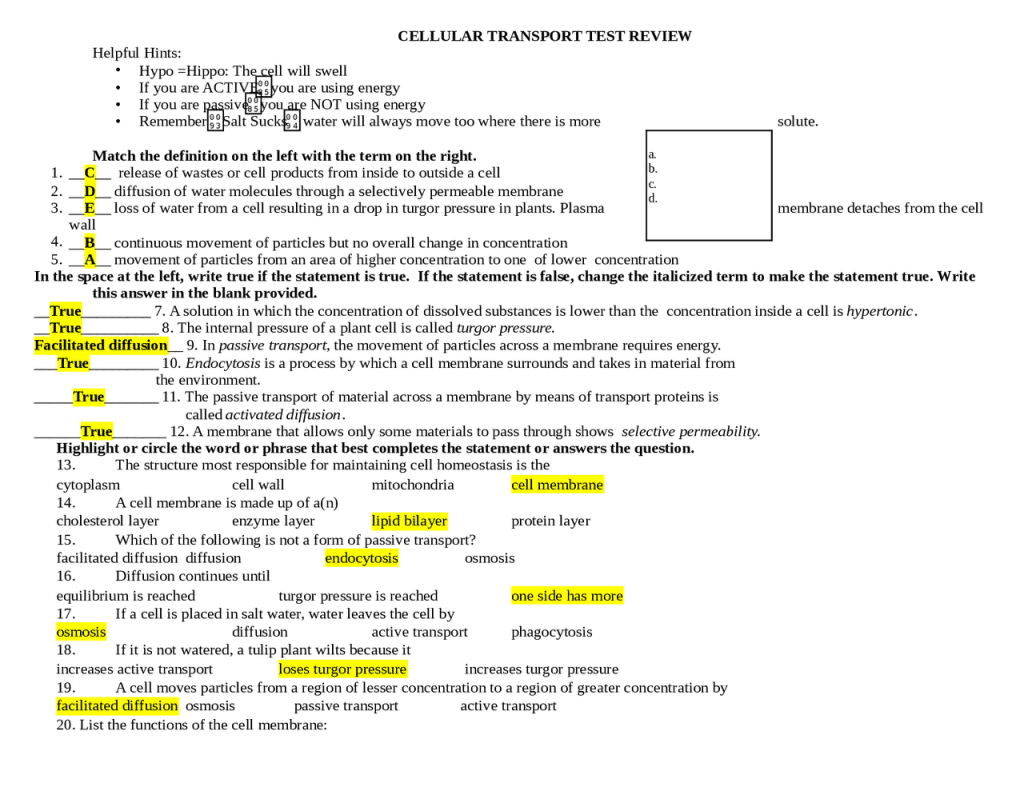
Understanding cell transport is essential in comprehending how cells maintain homeostasis and function properly. Cell transport refers to the movement of substances across the cell membrane, which is crucial for the exchange of nutrients, waste removal, and communication between cells. To fully grasp the concept of cell transport, it is important to ask and answer relevant questions that cover different aspects of this process.
In this article, we will explore a variety of cell transport questions that will help deepen your understanding of this fundamental biological process. By addressing these questions, you will gain insights into the different types of cell transport, the factors that influence transport, and the importance of cell transport in overall cell function.
Whether you are a student studying biology or someone interested in learning more about cell transport, these questions will serve as a valuable resource to enhance your knowledge and comprehension in this area.
See these cell transport questions
- What is cell transport?
- What are the different types of cell transport?
- How does simple diffusion occur?
- What is facilitated diffusion?
- How does osmosis work?
- What is active transport?
- What is endocytosis?
- What is exocytosis?
- What is the difference between passive and active transport?
- What factors affect the rate of diffusion?
- How does temperature influence cell transport?
- What role does concentration gradient play in cell transport?
- How does the size of molecules affect their transport across the cell membrane?
- What are carrier proteins?
- What is the purpose of channel proteins?
- What is the role of aquaporins in osmosis?
- How do cells regulate the movement of substances in and out of the cell?
- What is the difference between hypertonic, hypotonic, and isotonic solutions?
- How does water move in and out of cells in different tonicity conditions?
- What is the importance of sodium-potassium pumps in cell transport?
- How do vesicles aid in the transport of large molecules?
- What is the function of the cell membrane in cell transport?
- What happens when a cell is placed in a hypotonic solution?
- How do cells maintain homeostasis through cell transport?
- What is the role of ATP in active transport?
- What are the similarities and differences between active transport and facilitated diffusion?
- How does the cell membrane selectively allow certain substances to pass through?
- What is the role of ion channels in cell transport?
- How does endocytosis differ from exocytosis?
- What is the significance of cell transport in nerve impulse transmission?
- How do cells in the kidney regulate water balance through cell transport?
- What is the role of carrier proteins in glucose transport?
- What are the consequences of cell transport dysfunction?
- How does cell transport contribute to the immune response?
- What is the relationship between cell transport and drug delivery?
- How do cells in the digestive system transport nutrients?
- What is the role of cell transport in plant growth and development?
- How does cell transport contribute to muscle contraction?
- What are the challenges in studying cell transport?
- How does cell transport differ in prokaryotic and eukaryotic cells?
- What are the recent advancements in understanding cell transport?
These are just a few examples of the many questions that can be asked about cell transport. Exploring these questions and seeking answers will provide a solid foundation in understanding the intricate mechanisms that allow cells to transport substances effectively.
By acquiring knowledge in cell transport, we can better appreciate the complexity of life at the cellular level and gain insights into the functioning of various biological processes.






