
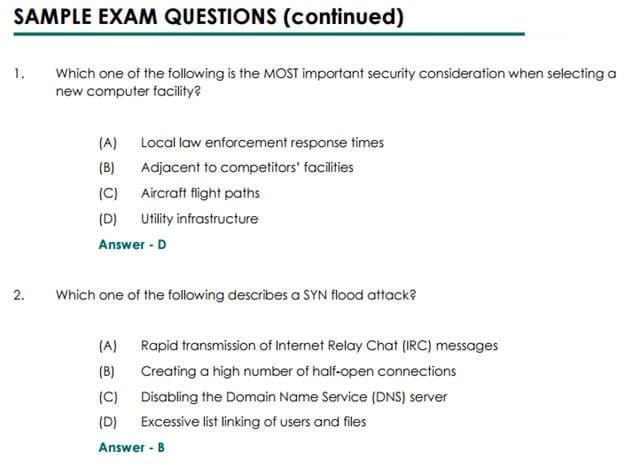
If you are preparing for the Certified Information Systems Security Professional (CISSP) certification exam, it is essential to practice with sample questions to enhance your understanding of the exam format and test your knowledge. CISSP is a globally recognized certification that validates your expertise in information security and is highly sought after by employers. In this article, we will provide you with a comprehensive list of CISSP sample questions to help you in your preparation for the exam.
Before diving into the sample questions, it is important to understand the CISSP exam structure. The CISSP exam consists of eight domains, namely Security and Risk Management, Asset Security, Security Architecture and Engineering, Communication and Network Security, Identity and Access Management (IAM), Security Assessment and Testing, Security Operations, and Software Development Security. It is crucial to have a solid understanding of these domains to pass the exam.
Now, let’s take a look at some CISSP sample questions that cover various domains of the CISSP exam:
See these CISSP sample questions
- 1. What is the primary goal of a risk management program?
- 2. What is the difference between confidentiality and integrity?
- 3. What are the key components of an access control matrix?
- 4. What is the purpose of a security policy?
- 5. What is the difference between symmetric and asymmetric encryption?
- 6. What are the different types of firewalls?
- 7. What is the purpose of a vulnerability assessment?
- 8. What are the steps involved in incident response?
- 9. What is the role of a Security Operations Center (SOC)?
- 10. What is the difference between penetration testing and vulnerability scanning?
- 11. What are the different types of intrusion detection systems?
- 12. What is the concept of defense in depth?
- 13. What is the purpose of a business continuity plan?
- 14. What is the role of a data owner?
- 15. What are the key principles of secure software development?
- 16. What is the purpose of a secure coding standard?
- 17. What is the difference between white-box and black-box testing?
- 18. What is the concept of least privilege?
- 19. What are the key components of a disaster recovery plan?
- 20. What is the role of a security architect?
- 21. What is the difference between authentication and authorization?
- 22. What is the purpose of a security awareness training program?
- 23. What are the different types of access control models?
- 24. What is the role of a security auditor?
- 25. What is the concept of separation of duties?
- 26. What are the different types of biometric authentication?
- 27. What is the purpose of a security incident response plan?
- 28. What is the difference between a vulnerability and an exploit?
- 29. What are the key components of a network security architecture?
- 30. What is the role of a security consultant?
- 31. What is the concept of secure coding practices?
- 32. What is the purpose of a security control?
- 33. What are the different types of encryption algorithms?
- 34. What is the role of a security administrator?
- 35. What is the difference between a risk and a threat?
- 36. What are the key components of a security incident response team?
- 37. What is the concept of least common mechanism?
- 38. What is the purpose of a security awareness campaign?
- 39. What are the different types of access control techniques?
- 40. What is the role of a security analyst?
These sample questions cover a wide range of topics that are crucial for the CISSP exam. It is recommended to practice with as many sample questions as possible to improve your chances of success. Additionally, it is essential to study the official CISSP study guide and other relevant resources to deepen your understanding of the exam content.
Remember, the key to passing the CISSP exam is a combination of knowledge, practice, and a strategic approach. Good luck with your preparation!






