
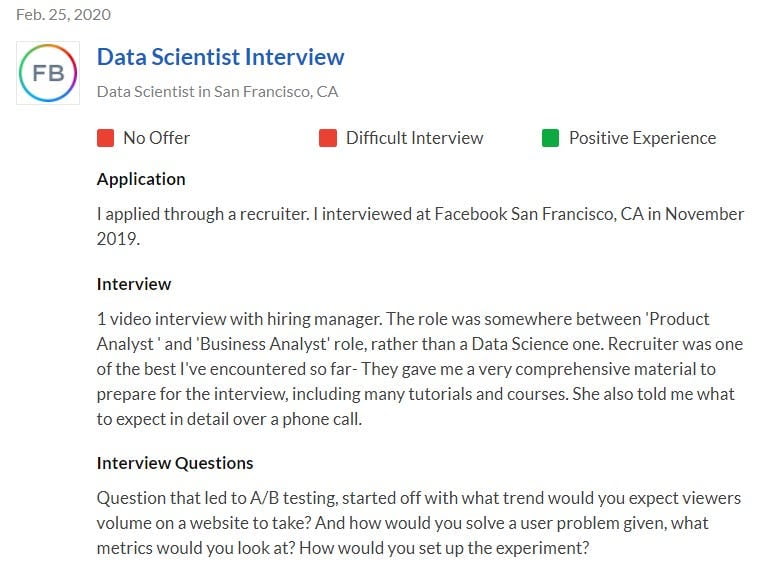
When preparing for a data science interview at Facebook, it is essential to familiarize yourself with the specific interview questions that may be asked. Facebook, being one of the leading social media platforms, has a strong focus on data science to analyze and understand user behavior, improve algorithms, and enhance user experience. In this article, we will provide a comprehensive list of Facebook data science interview questions to help you prepare and increase your chances of success.
Facebook data science interviews typically consist of a combination of technical and behavioral questions. Technical questions assess your understanding of statistics, machine learning, programming, and data analysis. Behavioral questions aim to evaluate your problem-solving skills, ability to work in a team, and communication skills. By familiarizing yourself with these questions, you can confidently showcase your knowledge and skills during the interview.
Below, you will find a comprehensive list of Facebook data science interview questions that cover various topics, including statistics, machine learning, programming, and more. This list will help you prepare and excel in your upcoming interview:
See these Facebook Data Science Interview Questions
- What is the difference between supervised and unsupervised learning?
- How would you handle missing data in a dataset?
- Explain the bias-variance tradeoff.
- What are the different types of regression?
- What is the curse of dimensionality?
- How would you handle imbalanced datasets?
- What is A/B testing and how would you implement it?
- Explain the concept of regularization.
- What is the Central Limit Theorem?
- How would you deal with outliers in a dataset?
- What is collaborative filtering?
- Explain the concept of gradient descent.
- What is the difference between bagging and boosting?
- How do you handle multicollinearity in regression?
- What is the difference between precision and recall?
- Explain the concept of deep learning.
- How would you handle a dataset with a large number of features?
- What is the purpose of a decision tree?
- What is the difference between overfitting and underfitting?
- Explain the concept of feature engineering.
- How would you handle a dataset with a high dimensionality?
- What is the purpose of a confusion matrix?
- What is the difference between K-means and hierarchical clustering?
- Explain the concept of cross-validation.
- How would you detect and handle outliers in a time series dataset?
- What is the purpose of regularization techniques in machine learning?
- What is the difference between probability and likelihood?
- Explain the concept of natural language processing.
- How would you handle class imbalance in a classification problem?
- What is the purpose of dimensionality reduction techniques?
- What is the difference between L1 and L2 regularization?
- Explain the concept of word embedding.
- How would you deal with missing values in a time series dataset?
- What is the purpose of feature scaling in machine learning?
- What is the difference between generative and discriminative models?
- Explain the concept of sentiment analysis.
- How would you handle class imbalance in a regression problem?
- What is the purpose of outlier detection techniques?
- What is the difference between batch gradient descent and stochastic gradient descent?
- Explain the concept of topic modeling.
- How would you handle data leakage in a machine learning model?
- What is the purpose of imputation techniques in data analysis?
- What is the difference between time series forecasting and regression?
- Explain the concept of recommendation systems.
- How would you handle unbalanced classes in a multi-class classification problem?
Remember, these are just a few examples of the types of questions you may encounter during a Facebook data science interview. It is essential to thoroughly understand the underlying concepts and be able to apply them to real-world scenarios. Good luck with your interview preparation!






