
Fahrenheit 451 is a dystopian novel written by Ray Bradbury, published in 1953. Set in a future society where books are banned and burned, the story follows Guy Montag, a fireman tasked with destroying any remaining books. However, as Montag begins to question his role in this oppressive society, he meets Granger, a leader of a group of outcasts known as the “book people.” Granger is a wise and insightful character who shares several thought-provoking quotes throughout the novel.
In Fahrenheit 451, Granger serves as a mentor figure for Montag, guiding him towards a deeper understanding of the power of literature and knowledge. Granger’s quotes are not only significant within the context of the story but also offer profound insights into the importance of books, freedom of speech, and the dangers of censorship.
Here are some notable Granger quotes from Fahrenheit 451:
Read these Fahrenheit 451 Granger Quotes
“We’re going to meet a lot of lonely people in the next week and the next month and the next year. And when they ask us what we’re doing, you can say, We’re remembering. That’s where we’ll win out in the long run. And someday we’ll remember so much that we’ll build the biggest goddamn steamshovel in history and dig the biggest grave of all time and shove war in and cover it up.”
“I wanted to know what the words meant. I wanted to know how things worked. I wanted to know why. I remember that day sitting under the stairs and – the fact that I’m here now, I guess I never knew how bored I was.”
“We’re nothing more than dust jackets for books, of no significance otherwise.”
“You’re not important. You’re not anything. Someday the load we’re carrying with us may help someone. But even when we had the books on hand, a long time ago, we didn’t use what we got out of them. We went right on insulting the dead. We went right on spitting in the graves of all the poor ones who died before us. We’re going to meet a lot of lonely people in the next week and the next month and the next year. And when they ask us what we’re doing, you can say, We’re remembering.”
“The books are to remind us what asses and fools we are.”
“A book is a loaded gun in the house next door. Burn it. Take the shot from the weapon. Breach man’s mind. Who knows who might be the target of the well-read man?”
“We’re all fools,” said Clemens, “all the time. It’s just we’re a different kind each day. We think, I’m not a fool today. I’ve learned my lesson. I was a fool yesterday but not this morning. Then tomorrow we find out that, yes, we were a fool today too. I think the only way we can grow and get on in this world is to accept the fact we’re not perfect and live accordingly.”
“We’re going to need not only the books we’ve read but all the books we can get. We need to stop being afraid of the knowledge we’re accumulating. We need to embrace it.”
“Stuff your eyes with wonder,” he said, “live as if you’d drop dead in ten seconds. See the world. It’s more fantastic than any dream made or paid for in factories.”
“There is no terror, Cassius, in your threats, for I am armed so strong in honesty that they pass by me as an idle wind, which I respect not!”
“You’re afraid of making mistakes. Don’t be. Mistakes can be profited by. Man, when I was younger I shoved my ignorance in people’s faces. They beat me with sticks. By the time I was forty my blunt instrument had been honed to a fine cutting point for me. If you hide your ignorance, no one will hit you and you’ll never learn.”
“Everyone must leave something behind when he dies, my grandfather said. A child or a book or a painting or a house or a wall built or a pair of shoes made. Or a garden planted. Something your hand touched some way so your soul has somewhere to go when you die, and when people look at that tree or that flower you planted, you’re there.”
“The magic is only in what books say, how they stitched the patches of the universe together into one garment for us.”
“We know all the damn silly things we’ve done for a thousand years, and as long as we know that and always have it around where we can see it, someday we’ll stop making the goddamn funeral pyres and jumping into the middle of them.”
“Do you know why books such as this are so important? Because they have quality. And what does the word quality mean? To me, it means texture. This book has pores. It has features.”
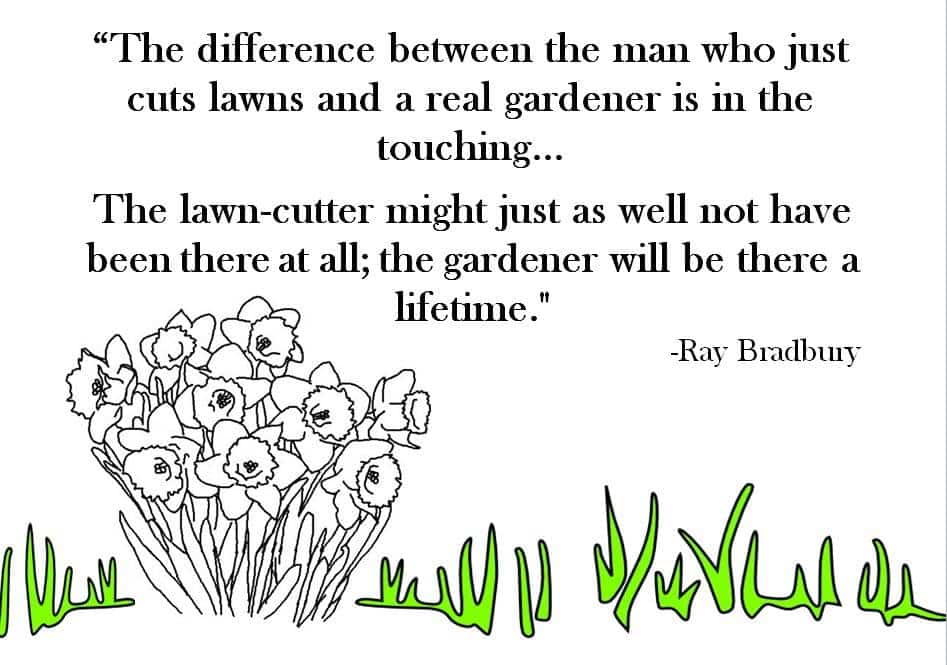
“The difference between the man who just cuts lawns and a real gardener is in the touching, he said. The lawn-cutter might just as well not have been there at all; the gardener will be there a lifetime.”
“We’re all fools,” said Clemens, “all the time. It’s just we’re a different kind each day. We think, I’m not a fool today. I’ve learned my lesson. I was a fool yesterday but not this morning. Then tomorrow we find out that, yes, we were a fool today too. I think the only way we can grow and get on in this world is to accept the fact we’re not perfect and live accordingly.”
“What is there about fire that’s so lovely? No matter what age we are, what draws us to it? It’s perpetual motion; the thing man wanted to invent but never did. Or almost perpetual motion. If you let it go on, it’d burn our lifetimes out. What is fire? It’s a mystery. Scientists give us gobbledegook about friction and molecules. But they don’t really know.”
“You’re not important. You’re not anything. Someday the load we’re carrying with us may help someone. But even when we had the books on hand, a long time ago, we didn’t use what we got out of them. We went right on insulting the dead. We went right on spitting in the graves of all the poor ones who died before us.”
“We’re going to meet a lot of lonely people in the next week and the next month and the next year. And when they ask us what we’re doing, you can say, We’re remembering. That’s where we’ll win out in the long run. And someday we’ll remember so much that we’ll build the biggest goddamn steamshovel in history and dig the biggest grave of all time and shove war in and cover it up.”
“The books are to remind us what asses and fools we are. They’re Caesar’s praetorian guard, whispering as the parade roars down the avenue, ‘Remember, Caesar, thou art mortal.’ Most of us can’t rush around, talking to everyone, know all the cities of the world, we haven’t time, money, or that many friends. The things you’re looking for, Montag, are in the world, but the only way the average chap will ever see ninety-nine percent of them is in a book.”
“We have everything we need to be happy, but we aren’t happy. Something’s missing. I looked around. The only thing I positively knew was gone was the books I’d burned in ten or twelve years. So I thought books might help.”
“We must all be alike. Not everyone born free and equal, as the Constitution says, but everyone made equal. Each man the image of every other; then all are happy, for there are no mountains to make them cower, to judge themselves against. So! A book is a loaded gun in the house next door. Burn it. Take the shot from the weapon. Breach man’s mind. Who knows who might be the target of the well-read man?”
These quotes from Granger in Fahrenheit 451 offer a glimpse into the profound themes of the novel. They highlight the importance of preserving knowledge, embracing curiosity, and challenging the status quo. As readers, we are reminded of the power of books to shape our understanding of the world and inspire us to think critically. Granger’s words serve as a call to action, urging us to value the freedom of speech and resist any attempts to suppress it.






