
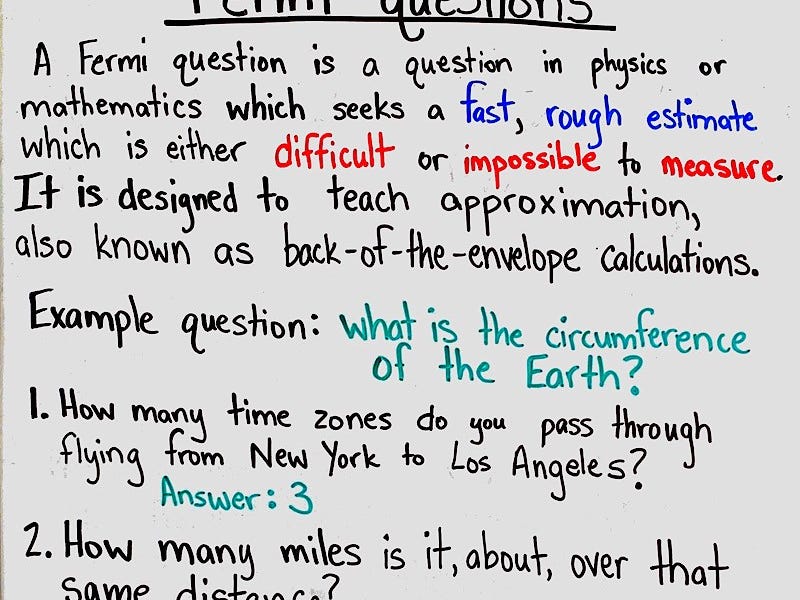
Have you ever wondered how many piano tuners are in New York City? Or how many golf balls can fit inside a school bus? These seemingly impossible questions to answer accurately are known as Fermi questions. Named after the renowned physicist Enrico Fermi, these questions are designed to test a person’s ability to make rough estimations based on logical reasoning and available information. In this article, we will explore the concept of Fermi questions and provide you with a list of intriguing examples.
Enrico Fermi, a Nobel Prize-winning physicist, was known for his ability to make quick and accurate estimations. He believed that a person could arrive at a reasonable approximation to an answer by making a series of simplifying assumptions and using basic calculations. Fermi questions often involve complex topics such as astronomy, physics, or mathematics, but the goal is not to provide an exact answer. Instead, the focus is on developing critical thinking skills and the ability to break down complex problems into manageable parts.
One of the most famous Fermi questions is “How many piano tuners are in New York City?” While it may seem impossible to count every piano tuner in a city as large as New York, Fermi questions encourage individuals to think creatively and consider various factors that could affect the answer. By estimating the number of households, the percentage of households that own a piano, and the average number of pianos tuned per year, one can arrive at a reasonable approximation.
See these Fermi questions
- How many blades of grass are in a football field?
- How many bricks would it take to build a wall around the Earth?
- How many water molecules are there in the ocean?
- How many hairs are on a human head?
- How many ants are there in the world?
- How many people have ever lived on Earth?
- How many stars are in the Milky Way galaxy?
- How many breaths does a person take in a lifetime?
- How many trees are there in the Amazon rainforest?
- How many words are in the English language?
- How many cells are in the human body?
- How many grains of sand are on a beach?
- How many cars are there in the world?
- How many atoms are in a grain of salt?
- How many bacteria are in a human mouth?
- How many steps does it take to climb Mount Everest?
- How many books are in the Library of Congress?
- How many hours of video are uploaded to YouTube every minute?
- How many stars are visible to the naked eye?
- How many gallons of water are in the Pacific Ocean?
- How many leaves are on an oak tree?
- How many jelly beans can fit in a jar?
- How many satellites are orbiting the Earth?
- How many cells are in a banana?
- How many grains of rice are in a bag?
- How many hours of sleep does the average person need?
- How many teeth does a shark have?
- How many neurons are in the human brain?
- How many pounds of food does a person eat in a year?
- How many planets are in our solar system?
- How many days does it take for the Earth to orbit the Sun?
- How many minutes does it take for light to travel from the Sun to Earth?
- How many cells are in a beehive?
- How many steps does it take to walk around the world?
- How many bacteria are on a human hand?
- How many words does the average person speak in a day?
- How many fish are in the ocean?
- How many beats per minute does the average heart have?
- How many calories are burned during a marathon?
- How many pencils are produced each year?
- How many emails are sent worldwide every day?
- How many petals does a rose have?
- How many stars are in the observable universe?
- How many grains of sand are in the Sahara Desert?
These are just a few examples of Fermi questions that can exercise your logical thinking and estimation skills. Remember, the goal is not to achieve a precise answer, but to develop your ability to think critically and make rough estimations based on available information. So the next time you come across a seemingly impossible question, channel your inner Fermi and start estimating!






