
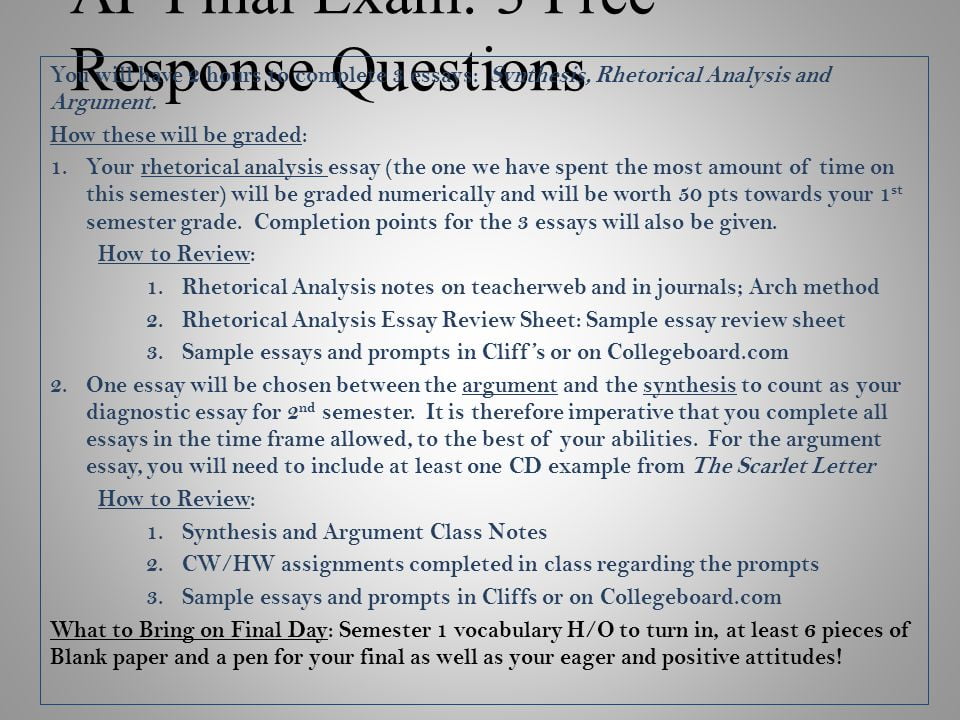
Free response questions, also known as open-ended questions, are a type of assessment in which individuals are required to provide their own answers or explanations. These questions are commonly used in educational settings, such as exams, quizzes, and assignments, to evaluate students’ knowledge and understanding of a particular subject. Free response questions allow individuals to demonstrate their critical thinking skills, creativity, and ability to articulate their thoughts effectively.
Unlike multiple-choice questions that provide a set of predetermined options, free response questions require individuals to generate their own responses. This format allows for a more in-depth exploration of the topic and provides an opportunity for individuals to showcase their unique perspectives and insights. Free response questions are often used in subjects such as English, history, science, and mathematics, where there may be multiple correct answers or a need for explanation and analysis.
One of the benefits of using free response questions is that they encourage higher-order thinking skills. By requiring individuals to think critically, analyze information, and synthesize ideas, free response questions promote a deeper understanding of the subject matter. Additionally, these questions allow educators to assess individuals’ problem-solving abilities, communication skills, and ability to apply their knowledge to real-world situations.
See these free response questions
- Describe the main themes in the novel “To Kill a Mockingbird” by Harper Lee.
- Explain the process of photosynthesis and its importance in the ecosystem.
- Discuss the causes and consequences of the American Civil War.
- Analyze the role of gender in Shakespeare’s play “Macbeth.”
- Compare and contrast the economic systems of capitalism and socialism.
- Explain the process of mitosis and its significance in cell division.
- Discuss the impact of social media on society.
- Analyze the effects of climate change on the environment.
- Describe the steps involved in solving a quadratic equation.
- Discuss the ethical implications of genetic engineering.
- Explain the concept of supply and demand in economics.
- Analyze the symbolism in F. Scott Fitzgerald’s novel “The Great Gatsby.”
- Discuss the causes and consequences of the French Revolution.
- Describe the structure and function of the human respiratory system.
- Analyze the impact of globalization on culture and identity.
- Discuss the factors contributing to income inequality in modern society.
- Explain the process of natural selection and its role in evolution.
- Compare and contrast the theories of Freud and Jung in psychology.
- Analyze the role of propaganda in shaping public opinion.
- Discuss the impact of technology on education.
- Describe the process of digestion in the human body.
- Analyze the causes and consequences of World War II.
- Discuss the ethical considerations of cloning.
- Explain the concept of elasticity in economics.
- Compare and contrast the theories of behaviorism and cognitivism in psychology.
- Analyze the role of media in politics.
- Discuss the impact of globalization on the economy.
- Describe the structure and function of the human nervous system.
- Analyze the effects of poverty on individuals and society.
- Explain the process of cellular respiration and its importance in energy production.
- Discuss the causes and consequences of the Industrial Revolution.
- Describe the process of memory formation and retrieval in the human brain.
- Analyze the role of religion in society.
- Discuss the impact of immigration on the labor market.
- Explain the concept of market equilibrium in economics.
- Compare and contrast the theories of structuralism and functionalism in psychology.
- Analyze the role of the judiciary in a democratic society.
- Discuss the impact of social media on mental health.
- Describe the process of protein synthesis in cells.
- Analyze the causes and consequences of the Cold War.
- Discuss the ethical considerations of animal testing.
- Explain the concept of inflation and its effects on the economy.
- Compare and contrast the theories of humanism and behaviorism in psychology.
- Analyze the role of the United Nations in international relations.
- Discuss the impact of climate change on human health.
These free response questions provide a glimpse into the wide range of topics that can be explored and assessed using this format. Whether you are a student preparing for an exam or an educator looking for ways to evaluate students’ understanding, free response questions offer a valuable tool for assessing knowledge, critical thinking, and communication skills.






