
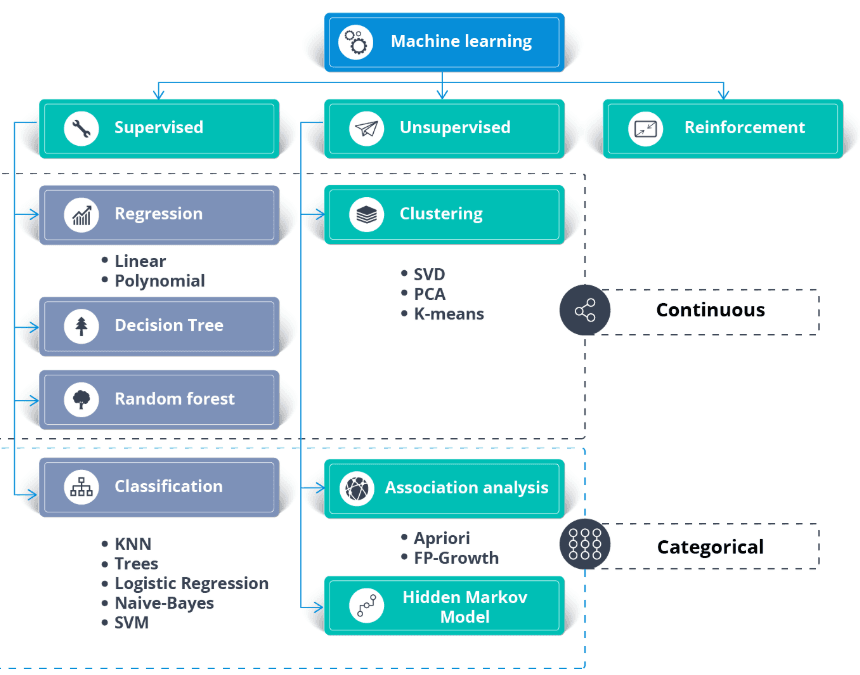
Machine Learning has become an integral part of many industries, and Google is at the forefront of this revolutionary technology. As a leader in the field, Google hires top talent in the Machine Learning domain, and their interview process reflects their high standards.
If you are preparing for a Google Machine Learning interview, it is essential to familiarize yourself with the types of questions that may be asked. In this article, we have compiled a comprehensive list of Google Machine Learning interview questions that will help you in your preparation.
Whether you are a seasoned Machine Learning professional or a fresh graduate looking to kickstart your career in this field, these questions will provide you with insights into the skills and knowledge Google values in its Machine Learning candidates.
See these Google Machine Learning Interview Questions
- What is the difference between supervised and unsupervised learning?
- Explain the bias-variance tradeoff in Machine Learning.
- What are the different evaluation metrics used for classification models?
- What is the purpose of regularization in Machine Learning models?
- How does gradient descent work?
- Explain the concept of overfitting and how to avoid it.
- What is the difference between bagging and boosting?
- What is the role of activation functions in neural networks?
- What is the difference between a generative and discriminative model?
- Explain the concept of feature selection and its importance.
- What is the difference between precision and recall?
- How do you handle missing data in a dataset?
- Explain the concept of cross-validation.
- What is the purpose of dimensionality reduction in Machine Learning?
- How does the k-nearest neighbors algorithm work?
- What is the difference between L1 and L2 regularization?
- Explain the concept of transfer learning.
- What is the role of the learning rate in gradient descent?
- How do you handle imbalanced datasets?
- What is the difference between a support vector machine and logistic regression?
- Explain the concept of ensemble learning.
- What is the difference between a decision tree and a random forest?
- How do you handle categorical variables in a Machine Learning model?
- What is the role of dropout in neural networks?
- Explain the concept of backpropagation.
- What is the difference between batch gradient descent and stochastic gradient descent?
- How do you handle outliers in a dataset?
- What is the purpose of the ROC curve?
- Explain the concept of data augmentation.
- What is the difference between a shallow and deep neural network?
- How do you handle multicollinearity in regression models?
- What is the purpose of the activation function in a neural network?
- Explain the concept of the curse of dimensionality.
- What is the difference between L1 and L2 loss functions?
- How do you handle time series data in Machine Learning?
- What is the purpose of the F1 score?
- Explain the concept of transfer learning in convolutional neural networks.
- What is the difference between a generative and discriminative model?
- How do you handle imbalanced datasets in classification models?
- What is the role of dropout in convolutional neural networks?
- Explain the concept of word embedding in natural language processing.
- What is the difference between word2vec and GloVe?
- How do you handle missing values in time series data?
- What is the purpose of the attention mechanism in neural networks?
- Explain the concept of long short-term memory (LSTM) in recurrent neural networks.
These are just a few examples of the types of questions you may encounter in a Google Machine Learning interview. It is crucial to have a solid understanding of the fundamental concepts and techniques in Machine Learning to confidently tackle these questions.
Remember, preparation is the key to success, and practicing with these interview questions will help you showcase your expertise and stand out during your Google Machine Learning interview.






