
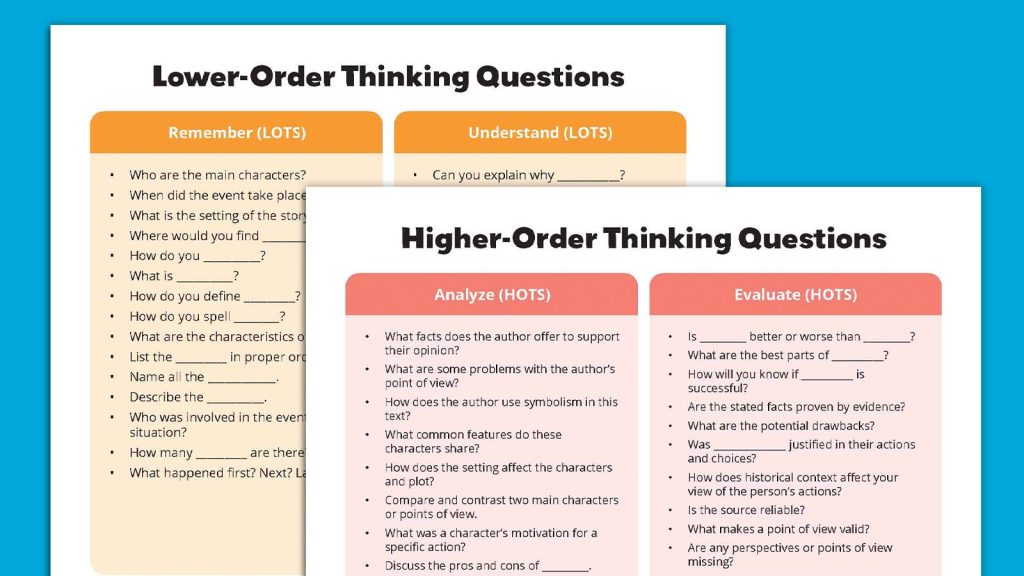
Science education plays a crucial role in developing critical thinking skills among students. Higher order thinking questions in science are designed to encourage students to think deeply, analyze information, and apply their knowledge to solve complex problems. These questions promote a deeper understanding of scientific concepts and allow students to develop skills such as reasoning, problem-solving, and scientific inquiry. In this article, we will explore the importance of higher order thinking questions in science and provide a list of 40 such questions to enhance learning and engagement in the classroom.
Higher order thinking questions in science go beyond simple recall or factual knowledge. They require students to apply their knowledge, analyze information, and evaluate evidence. These questions prompt students to think critically, make connections, and draw conclusions based on evidence. By engaging students in higher order thinking, teachers can foster a deeper understanding of scientific concepts and promote lifelong learning.
Moreover, higher order thinking questions in science encourage students to develop problem-solving skills. These questions require students to think creatively and explore multiple solutions. By challenging students to solve complex problems, they learn to think outside the box, approach challenges from different angles, and develop innovative solutions. These skills are essential for success in the scientific field and beyond.
See these higher order thinking questions in science:
- How does the process of photosynthesis contribute to the oxygen cycle?
- What evidence supports the theory of evolution?
- Compare and contrast the structure and function of animal and plant cells.
- What factors affect the rate of chemical reactions?
- How does the pH level of a solution impact enzyme activity?
- Explain the concept of natural selection and its role in the evolution of species.
- What are the potential consequences of climate change on ecosystems?
- Investigate and explain the relationship between temperature and the rate of evaporation.
- How does the human body maintain homeostasis?
- What are the potential benefits and drawbacks of genetically modified organisms?
- Design an experiment to test the effect of different fertilizers on plant growth.
- Explain the role of DNA in genetic inheritance.
- What are the ethical considerations in conducting scientific research involving human subjects?
- Analyze the impact of deforestation on biodiversity.
- How does the nervous system transmit signals?
- What are the advantages and disadvantages of renewable energy sources?
- Investigate the factors influencing the rate of osmosis in plant cells.
- What are the potential causes and consequences of ocean acidification?
- Explain the concept of energy transformation in different types of ecosystems.
- Compare and contrast the theories of relativity and quantum mechanics.
- How do vaccines work to prevent diseases?
- What are the potential applications of nanotechnology in medicine?
- Analyze the impact of human activities on the ozone layer.
- How does the process of cellular respiration contribute to the carbon cycle?
- What are the potential risks and benefits of using genetically modified crops?
- Investigate and explain the relationship between temperature and the solubility of a substance.
- Explain the concept of plate tectonics and its role in shaping Earth’s surface.
- What are the potential consequences of antibiotic resistance?
- How does the process of meiosis contribute to genetic diversity?
- What are the potential impacts of climate change on ocean currents?
- Analyze the factors influencing population growth in a given ecosystem.
- How does the human body respond to stress?
- What are the potential benefits and drawbacks of nuclear energy?
- Investigate and explain the relationship between light intensity and photosynthesis.
- Explain the concept of natural resources and their sustainable use.
- What are the potential consequences of air pollution on human health?
- Compare and contrast the structure and function of prokaryotic and eukaryotic cells.
- How do hormones regulate various physiological processes in the human body?
- What are the potential applications of stem cell research in medicine?
- Analyze the impact of human activities on freshwater ecosystems.
- How does the process of mitosis contribute to growth and repair in multicellular organisms?
- What are the potential risks and benefits of using pesticides in agriculture?
- Investigate and explain the relationship between pH and the growth of microorganisms.
- Explain the concept of energy conservation and its importance in sustainable development.
These higher order thinking questions in science are just a starting point. By incorporating a variety of such questions in classroom discussions and assignments, science teachers can encourage critical thinking, problem-solving, and scientific inquiry among their students. As students engage with these questions, they develop a deeper understanding of scientific concepts and become better equipped to tackle real-world challenges in the scientific field and beyond.






