
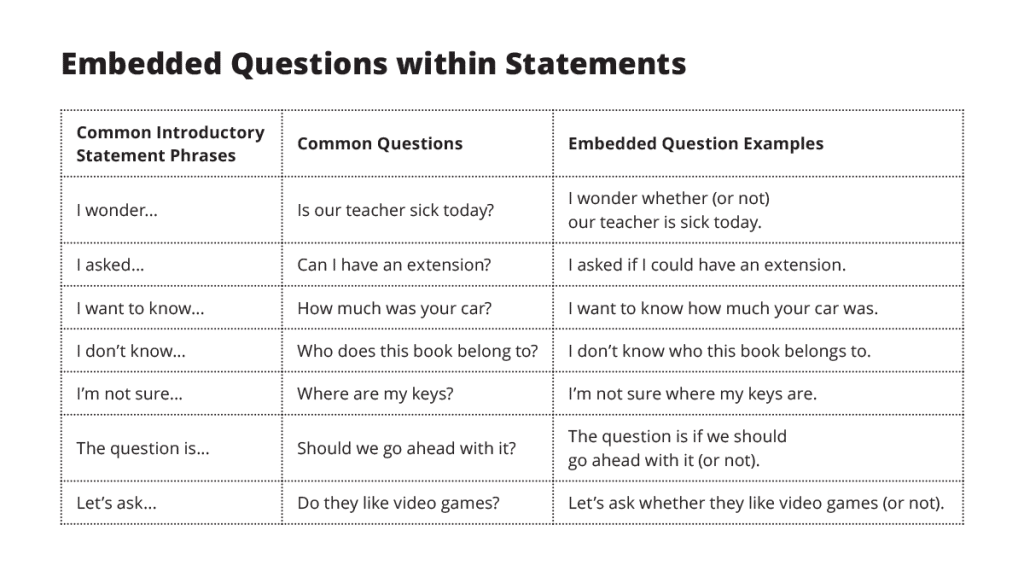
Have you ever wondered about the structure of questions in the English language? Inverted questions, also known as interrogative sentences, play a crucial role in communication. They allow us to seek information, express curiosity, and engage in meaningful conversations. Understanding the concept of inverted questions is essential for effective communication. In this article, we will explore the ins and outs of inverted questions, their structure, and their significance in English grammar.
An inverted question is a type of interrogative sentence that deviates from the standard subject-verb word order. Instead of the typical structure of subject-verb-object, inverted questions invert or reverse this order. This is achieved by placing the auxiliary verb or a modal verb before the subject. Inverted questions are commonly used in formal and informal contexts, such as interviews, surveys, and everyday conversations.
The main purpose of using inverted questions is to seek information or clarification. By reversing the word order, we can emphasize the question and show that we are expecting an answer. Additionally, inverted questions are often used to express surprise, disbelief, or curiosity. Mastering the art of constructing inverted questions will enhance your communication skills and make your conversations more engaging and interactive.
See these inverted questions:
- Can you pass me the salt?
- Have you seen the latest movie?
- Did you enjoy your vacation?
- Are you going to the party tonight?
- Could you please turn off the lights?
- Is it going to rain tomorrow?
- Should we book our tickets in advance?
- Will you be attending the conference?
- Did you finish your homework?
- Are they coming over for dinner?
- Can I borrow your pen?
- Have you ever been to Paris?
- Do you like chocolate ice cream?
- Is she coming to the meeting?
- Could you lend me some money?
- Will they be arriving on time?
- Did he call you yesterday?
- Can we meet for coffee tomorrow?
- Have you read the latest book by your favorite author?
- Do you know the answer to this question?
- Is it possible to learn a new language in three months?
- Should I take the train or the bus?
- Will she be joining us for dinner?
- Did you watch the football match last night?
- Can you help me with this math problem?
- Have you finished cooking dinner?
- Do they offer refunds for this product?
- Is there a supermarket nearby?
- Could you recommend a good restaurant in the area?
- Will he be attending the meeting tomorrow?
- Did you see the news about the new product launch?
- Can I have a glass of water, please?
- Have you ever visited the Grand Canyon?
- Do you believe in ghosts?
- Is she aware of the situation?
- Could you take a message for me?
- Will they be staying at the hotel or renting a house?
- Did he pass the exam?
- Can we discuss this matter in private?
- Have you heard about the upcoming concert?
- Do you know how to play the guitar?
- Is it worth investing in cryptocurrency?
These examples demonstrate the versatility and importance of inverted questions in everyday conversations. By incorporating inverted questions into your speech and writing, you can effectively engage with others, gather information, and express your thoughts and opinions. Whether you are a native English speaker or learning the language as a second language, understanding and utilizing inverted questions will undoubtedly enhance your communication skills and make you a more effective communicator.
In conclusion, inverted questions are an integral part of the English language. They allow us to seek information, express curiosity, and engage in meaningful conversations. By mastering the art of constructing inverted questions, you can enhance your communication skills and make your interactions more engaging and interactive. So, the next time you have a question, try using an inverted question to captivate your audience and elicit a thoughtful response.






