
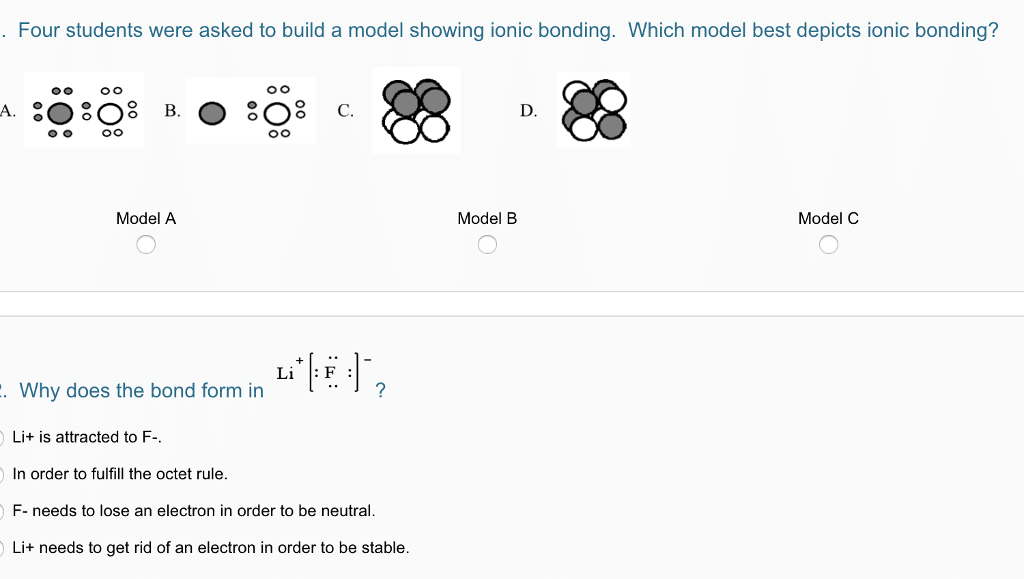
Ionic bonding is a fundamental concept in chemistry that involves the transfer of electrons between atoms. It is important to have a clear understanding of this concept in order to grasp the properties and behavior of ionic compounds. To help you in your studies, we have compiled a list of commonly asked questions about ionic bonding. Whether you are a student preparing for an exam or simply curious about the topic, these questions will provide you with valuable insights.
Understanding the basics of ionic bonding is crucial for comprehending the formation of compounds such as salts and understanding their properties. This article aims to address some common questions related to this topic, ranging from the definition of ionic bonding to more complex aspects like lattice energy and ionic radii.
Whether you are a beginner or an advanced learner, these questions will help solidify your knowledge and provide a strong foundation for further exploration into the fascinating world of ionic bonding.
See these Ionic Bonding Questions
- What is ionic bonding?
- How does ionic bonding occur?
- What is an ion?
- What are cations and anions?
- What are the main characteristics of ionic compounds?
- How do you determine the charge of an ion?
- What is an ionic bond?
- What is the difference between ionic and covalent bonding?
- What is an ionic lattice?
- What is lattice energy?
- How does lattice energy affect the stability of an ionic compound?
- What are the factors that influence lattice energy?
- What is the Born-Haber cycle?
- How do you calculate the lattice energy of an ionic compound?
- What is the relationship between lattice energy and ionic radii?
- What is an ionic radius?
- How does the size of an ion affect its stability?
- What is the octet rule?
- How does the octet rule apply to ionic bonding?
- What are polyatomic ions?
- How are polyatomic ions formed?
- What is the Lewis structure of an ion?
- What is an ionic equation?
- How do you balance ionic equations?
- What is the solubility of ionic compounds?
- How does temperature affect the solubility of ionic compounds?
- What is the relationship between ionic bonding and electronegativity?
- How do you determine the type of bonding in a compound?
- What are some examples of compounds with ionic bonding?
- What is the role of ionic bonding in electrostatic attraction?
- How does ionic bonding influence the physical properties of compounds?
- What is the role of ionic bonding in chemical reactions?
- What are some applications of ionic compounds in everyday life?
- How does ionic bonding contribute to the conductivity of solutions?
- What is the relationship between ionic bonding and melting/boiling points?
- What are the limitations of ionic bonding?
- How does the presence of a transition metal affect ionic bonding?
- What is the relationship between ionic bonding and crystal structures?
- How do you draw a Lewis dot structure for an ionic compound?
- What is the relationship between ionic bonding and the formation of precipitates?
- What are the factors that affect the strength of ionic bonding?
- What is the relationship between ionic bonding and the properties of ionic compounds?
- How does the presence of impurities affect the properties of ionic compounds?
These are just a few examples of the many questions that can arise when studying ionic bonding. By exploring and understanding these concepts, you will develop a solid foundation in chemistry and be able to apply your knowledge to various real-world scenarios.






