
When it comes to Java programming, understanding the Java Garbage Collector (GC) is crucial. The GC is responsible for automatically managing and reclaiming memory in Java applications. It plays a vital role in optimizing memory usage and ensuring the smooth execution of Java programs. As a result, many interviewers include questions about Java GC in their interviews to assess a candidate’s knowledge and expertise in Java memory management.
In this article, we will explore some commonly asked Java GC interview questions. Whether you are preparing for an interview or simply want to enhance your understanding of Java GC, these questions will help you grasp the key concepts and principles of memory management in Java.
So, let’s dive into the world of Java GC and explore some of the most frequently asked interview questions on this topic.
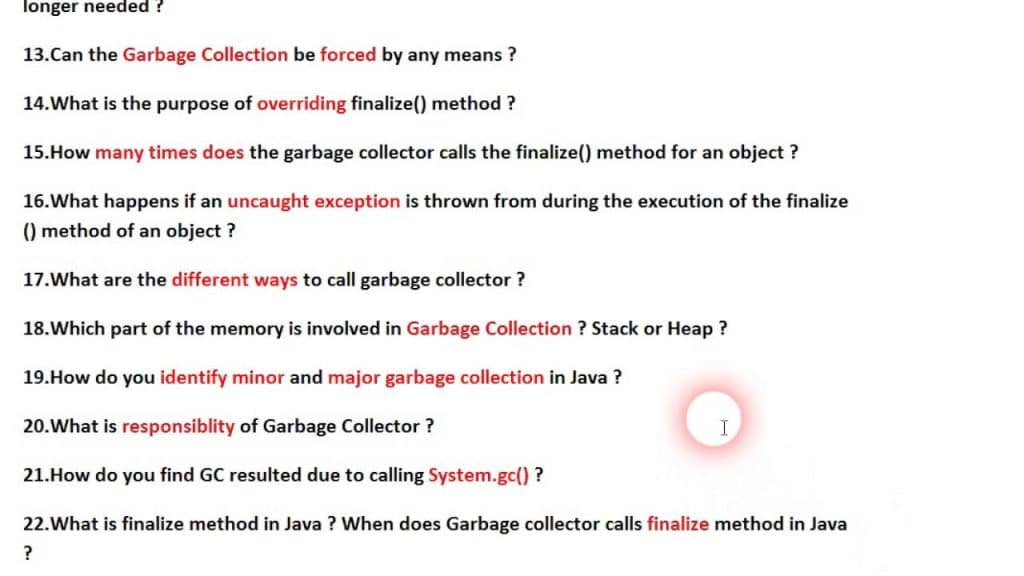
See these Java GC interview questions
- What is Java Garbage Collection?
- How does Java Garbage Collection work?
- What are the different types of GC algorithms in Java?
- What is the role of the ‘finalize()’ method in Java GC?
- What are the advantages and disadvantages of garbage collection?
- Explain the difference between ‘System.gc()’ and ‘Runtime.gc()’ methods.
- What is the purpose of the ‘finalize()’ method? Can we rely on it for resource cleanup?
- What is the significance of the ‘Heap’ and ‘Stack’ in Java GC?
- What is ‘Young Generation’ in Java GC?
- What is ‘Old Generation’ in Java GC?
- Explain the concept of ‘Minor GC’ and ‘Major GC’.
- What is the role of ‘PermGen’ or ‘Metaspace’ in Java GC?
- What is the purpose of the ‘Eden’ space in Java GC?
- How is memory allocated in the ‘Eden’ space?
- What is ‘Survivor’ space in Java GC?
- How does Java handle memory leaks?
- What is the purpose of the ‘OutOfMemoryError’ in Java GC?
- What are the different types of ‘OutOfMemoryError’ in Java?
- What is the purpose of the ‘OutOfMemoryError’ in Java GC?
- How can you prevent ‘OutOfMemoryError’ in Java?
- What is the difference between ‘SoftReference’ and ‘WeakReference’?
- How does Java handle circular references in garbage collection?
- What is the purpose of the ‘CMS’ garbage collector?
- What is the ‘G1’ garbage collector in Java?
- What are the different GC algorithms available in Java 8?
- How does Java GC differ in different versions of Java?
- What is the purpose of the ‘PhantomReference’ class?
- What is ‘Garbage First’ or ‘G1’ garbage collector in Java 9?
- What is the ‘Z Garbage Collector’ in Java?
- What is the purpose of ‘Epsilon’ garbage collector in Java 11?
- What is ‘Shenandoah’ garbage collector in Java?
- What is ‘ZGC’ or ‘Z Garbage Collector’ in Java 11?
- How can you tune the Java garbage collector for better performance?
- Explain the difference between ‘Serial’, ‘Parallel’, and ‘Concurrent’ garbage collectors.
- How does Java handle finalization and object resurrection?
- What is ‘Phantom Reference’ in Java GC?
- What is the difference between ‘Soft Reference’ and ‘Phantom Reference’?
- How does Java handle finalization and object resurrection?
- What are the best practices for memory management in Java?
- What is the purpose of the ‘PermGen’ or ‘Metaspace’ in Java GC?
- What are the different GC tuning options available in Java?
- What is the ‘ZGC’ or ‘Z Garbage Collector’ in Java?
- How does Java GC handle large object allocations?
- What is ‘Shenandoah’ garbage collector in Java?
These are just a few examples of Java GC interview questions that you may encounter during an interview. It is important to have a solid understanding of Java memory management and the various GC algorithms to confidently answer these questions. By familiarizing yourself with these topics and practicing your responses, you will be well-prepared to tackle any Java GC interview question that comes your way.






