
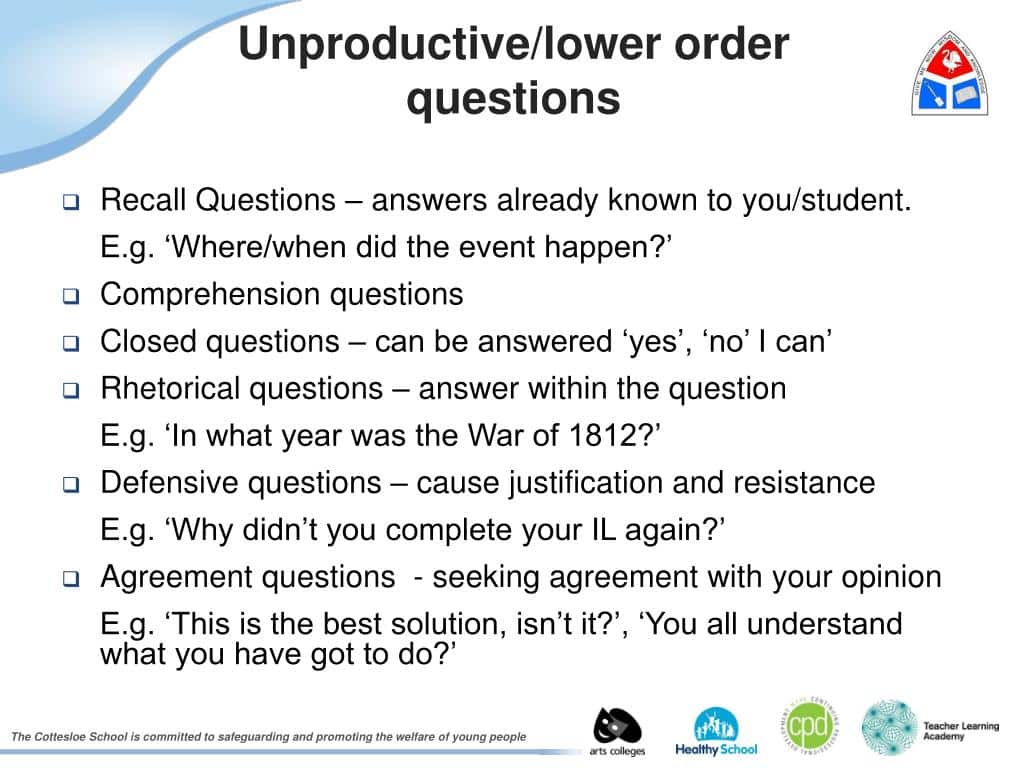
When it comes to questioning, there are different levels of complexity. Higher order questions require critical thinking and analysis, while lower order questions focus on basic knowledge and comprehension. While lower order questions may seem simple, they play a crucial role in learning and understanding a topic. In this article, we will explore the concept of lower order questions and their significance in education.
Lower order questions are designed to assess a student’s understanding of basic facts and concepts. These questions typically require simple recall or recognition of information. They can be answered with a single word or a short phrase. Lower order questions are often used to assess a student’s comprehension of a text or to review previously taught material.
Although lower order questions are often considered less challenging, they serve an important purpose in the learning process. They provide a foundation of knowledge that students can build upon. By answering lower order questions correctly, students demonstrate their understanding of fundamental concepts, which then enables them to tackle more complex ideas and questions.
See these lower order questions
- What is the capital of France?
- Who wrote “Romeo and Juliet”?
- What is the chemical symbol for gold?
- When did World War II end?
- What is the formula for calculating the area of a circle?
- What is the largest planet in our solar system?
- Who is the current President of the United States?
- What is the square root of 64?
- What is the formula for calculating density?
- Who discovered electricity?
- What is the atomic number of oxygen?
- What is the capital of Australia?
- Who painted the Mona Lisa?
- What is the formula for converting Celsius to Fahrenheit?
- What is the largest ocean on Earth?
- Who is the author of “To Kill a Mockingbird”?
- What is the chemical symbol for sodium?
- What is the square root of 81?
- What is the formula for calculating velocity?
- Who invented the telephone?
- What is the atomic number of hydrogen?
- What is the capital of Brazil?
- Who painted the Starry Night?
- What is the formula for converting Fahrenheit to Celsius?
- What is the deepest ocean trench in the world?
- Who is the author of “Pride and Prejudice”?
- What is the chemical symbol for carbon?
- What is the square root of 100?
- What is the formula for calculating acceleration?
- Who discovered the theory of relativity?
- What is the atomic number of helium?
- What is the capital of China?
- Who painted The Last Supper?
- What is the formula for converting kilometers to miles?
- What is the largest sea on Earth?
- Who is the author of “The Great Gatsby”?
- What is the chemical symbol for iron?
- What is the square root of 144?
- What is the formula for calculating force?
- Who discovered penicillin?
- What is the atomic number of nitrogen?
- What is the capital of India?
- Who painted Guernica?
- What is the formula for converting pounds to kilograms?
- What is the largest freshwater lake in the world?
These lower order questions cover a range of topics and test basic knowledge and understanding. They are an essential tool for educators to assess students’ comprehension and help them build a strong foundation for further learning. By incorporating lower order questions into lessons and assessments, teachers can ensure that students grasp essential facts and concepts before moving on to more complex material.
While higher order questions are important for critical thinking and analysis, lower order questions should not be overlooked. They provide the building blocks for deeper learning and are an integral part of a comprehensive education.






