
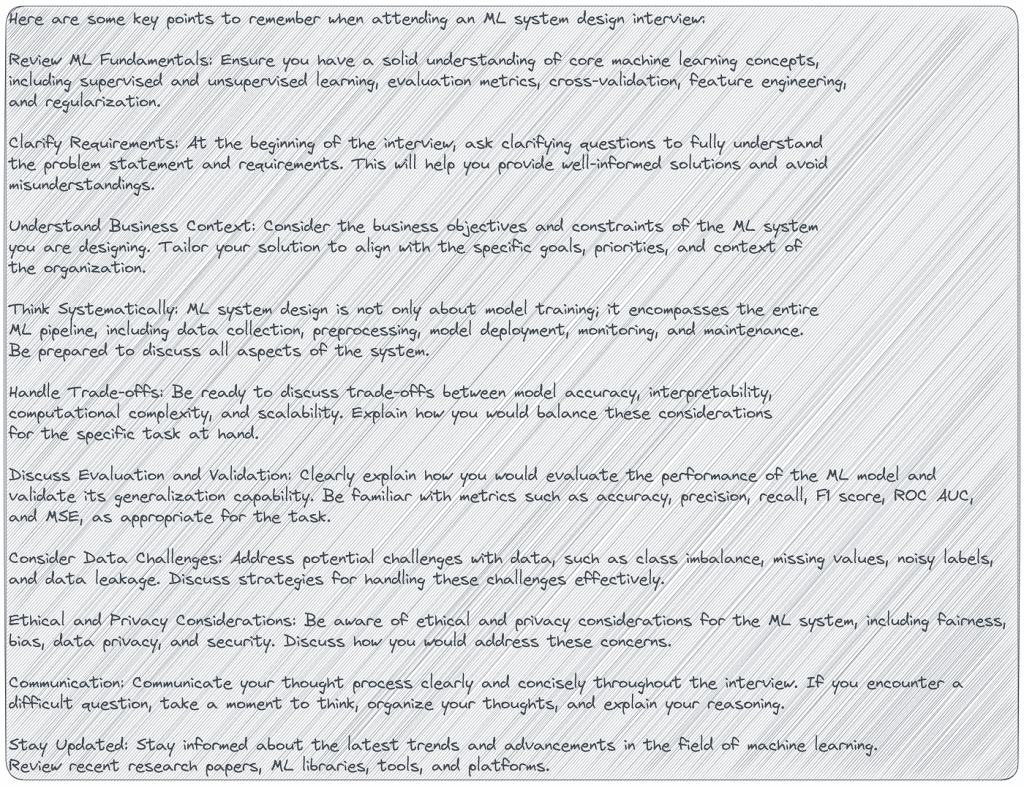
Machine learning has become an integral part of various industries, from healthcare to finance and beyond. As organizations increasingly rely on machine learning algorithms to make data-driven decisions, it is crucial to design robust and scalable ML systems. To ensure the success of these systems, it is important to ask the right questions during the design phase. In this article, we will explore some key ML system design questions that can help developers and engineers build efficient and effective ML systems.
When designing an ML system, it is important to start with a clear understanding of the problem at hand. What is the objective of the system? What data will be used? What are the desired outcomes? Answering these questions will guide the design process and ensure that the system meets the specific needs of the organization.
Another crucial aspect of ML system design is scalability. As organizations grow and generate more data, the ML system should be able to handle the increasing workload. Designing a scalable ML system involves considering factors such as distributed computing, parallel processing, and efficient data storage and retrieval mechanisms.
See these ml system design questions
- How will you preprocess and clean the data?
- What feature engineering techniques will you use?
- How will you handle missing data?
- What algorithms are suitable for the problem?
- How will you train and update the model?
- What performance metrics will you use to evaluate the model?
- How will you handle class imbalance?
- What steps will you take to prevent overfitting?
- How will you handle large datasets?
- What infrastructure and tools will you use for training and deployment?
- How will you handle privacy and security concerns?
- What techniques will you use to interpret and explain the model’s decisions?
- How will you monitor and maintain the ML system?
- What steps will you take to ensure fairness and avoid bias in the model?
- How will you handle concept drift in the data?
- What techniques will you use for model versioning and deployment?
- How will you handle real-time predictions?
- What steps will you take to ensure the reliability and robustness of the system?
- How will you handle noisy or incorrect data?
- What steps will you take to optimize the model’s performance?
- How will you handle feature selection and dimensionality reduction?
- What techniques will you use for model explainability and interpretability?
- How will you handle imbalanced or skewed datasets?
- What steps will you take to ensure the reproducibility of the results?
- How will you handle multi-modal or heterogeneous data?
- What techniques will you use for model ensembling and stacking?
- How will you handle non-stationary data?
- What steps will you take to handle data leakage?
- How will you handle feature scaling and normalization?
- What techniques will you use for model transfer learning?
- How will you handle time-series or sequential data?
- What steps will you take to handle outliers in the data?
- How will you handle interpretability versus performance trade-offs?
- What techniques will you use for model hyperparameter tuning?
- How will you handle biased or unrepresentative training data?
- What steps will you take to ensure the scalability of the system?
- How will you handle streaming or online learning scenarios?
- What techniques will you use for model compression and optimization?
- How will you handle distributed and parallel computing for training?
- What steps will you take to handle data privacy and compliance?
- How will you handle model retraining and continuous learning?
- What techniques will you use for model interpretability and explainability?
- How will you handle inference latency and real-time predictions?
- What steps will you take to ensure the fairness and ethics of the ML system?
- How will you handle adversarial attacks and model robustness?
These are just a few examples of the many important questions to consider when designing ML systems. By addressing these questions and tailoring the system design to the specific needs and requirements of the organization, developers and engineers can build ML systems that are robust, scalable, and effective in solving real-world problems.






