
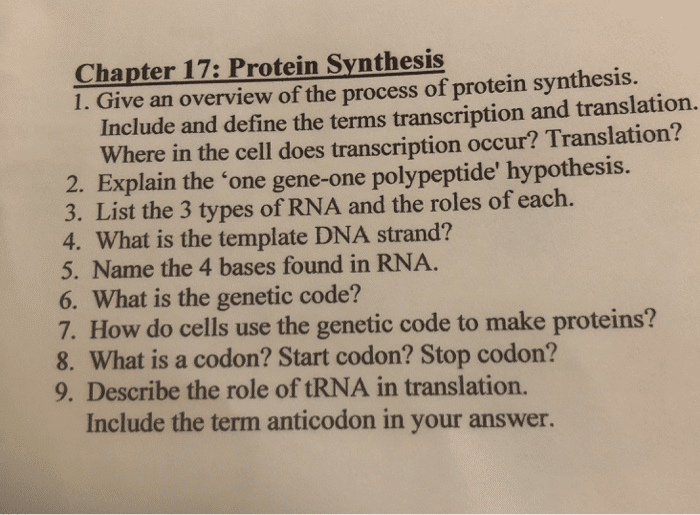
Protein synthesis is a fundamental process that occurs in all living organisms. It is the process by which the genetic information stored in DNA is used to create functional proteins. Understanding the intricacies of protein synthesis is essential for students and professionals in fields such as biology, biochemistry, and genetics. In this article, we will explore some frequently asked questions and provide detailed answers to help you grasp the concepts of protein synthesis.
See these protein synthesis questions and answers
- What is protein synthesis?
- What is transcription?
- What is translation?
- What is the role of ribosomes in protein synthesis?
- How does the genetic code determine protein synthesis?
- What is the significance of protein synthesis?
- What are the three stages of transcription?
- What are the differences between transcription and translation?
- What is the role of tRNA in translation?
- What is a mutation in protein synthesis?
Protein synthesis refers to the cellular process by which amino acids are arranged in a specific order to form proteins. It involves two main steps: transcription and translation.
Transcription is the first step of protein synthesis. It is the process in which the DNA sequence is copied into a messenger RNA (mRNA) molecule by an enzyme called RNA polymerase.
Translation is the second step of protein synthesis. It is the process in which the mRNA sequence is decoded by ribosomes to synthesize a specific protein. It involves the participation of transfer RNA (tRNA) molecules.
Ribosomes are the cellular structures that facilitate protein synthesis. They read the mRNA sequence and match it with the appropriate tRNA molecule carrying the corresponding amino acid. Ribosomes then link the amino acids together to form a protein chain.
The genetic code is a set of rules that defines how the sequence of nucleotides in DNA is translated into the sequence of amino acids in a protein. Each set of three nucleotides, known as a codon, codes for a specific amino acid or a stop signal.
Protein synthesis is crucial for the growth, development, and maintenance of living organisms. Proteins are involved in various cellular processes, including cell signaling, enzymatic reactions, structural support, and immune response.
The three stages of transcription are initiation, elongation, and termination. During initiation, RNA polymerase binds to the DNA at a specific region called the promoter. Elongation involves the synthesis of the mRNA molecule, and termination occurs when RNA polymerase reaches a termination sequence.
Transcription occurs in the nucleus and involves the synthesis of mRNA from a DNA template, while translation occurs in the cytoplasm and involves the synthesis of a protein from an mRNA template. Transcription produces an RNA molecule, whereas translation produces a protein molecule.
tRNA molecules act as carriers of amino acids during translation. Each tRNA molecule recognizes a specific codon on the mRNA and brings the corresponding amino acid to the ribosome for protein synthesis.
A mutation is a change in the DNA sequence that can affect protein synthesis. It can lead to the production of a non-functional protein or an altered protein with different properties.
This is just a small sample of the many protein synthesis questions that can arise. By understanding the answers to these questions, you will have a solid foundation in the field of protein synthesis. Keep exploring, and soon you’ll be able to tackle more complex concepts and dive deeper into this fascinating biological process.






