
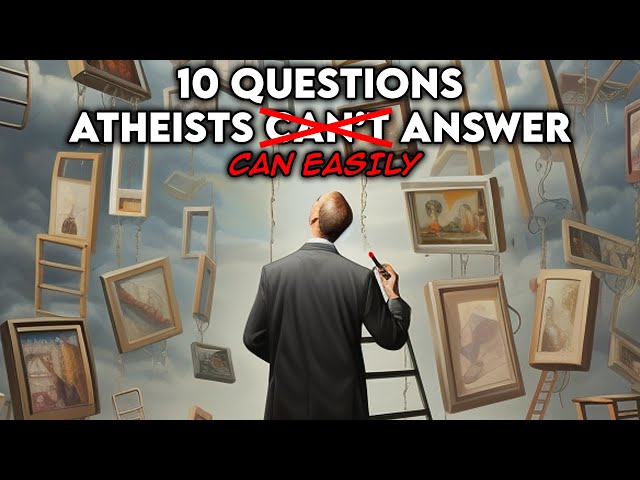
Atheism is a belief system that rejects the existence of a higher power or deity. While atheists often pride themselves on their rationality and evidence-based thinking, there are certain questions that challenge their worldview. These questions highlight the limitations of atheism when it comes to explaining the mysteries of our universe. In this article, we will explore some thought-provoking questions that atheists find difficult to answer.
It is important to note that not all atheists will struggle with these questions, as atheism is a diverse belief system with various interpretations. However, these questions can spark meaningful discussions and encourage atheists to critically examine their own beliefs.
While atheists may argue that the burden of proof lies with religious believers, it is worth considering the following questions that challenge the foundations of atheism:
See These Questions Atheists Can’t Answer
- What caused the Big Bang?
- How did life originate from non-living matter?
- What is the purpose or meaning of life?
- Why is there something rather than nothing?
- What is the origin of consciousness?
- How do you explain the fine-tuning of the universe?
- Can morality exist without a higher power?
- Why do we have a sense of beauty and appreciation for art?
- If God doesn’t exist, why do so many people believe in him?
- How do you explain the existence of objective moral values?
- Why do humans have a desire for spiritual experiences?
- What is the origin of the laws of logic and mathematics?
- Why is there suffering and evil in the world?
- How can consciousness and free will emerge from purely material processes?
- What caused the first life forms to evolve and reproduce?
- Why does the universe exhibit order and predictability?
- Can atheism provide a coherent and comprehensive worldview?
- How do atheists explain the existence of beauty and aesthetics?
- What gives life meaning and purpose in the absence of a higher power?
- How do atheists account for the complexity and design in nature?
- Why do humans have a longing for transcendence and immortality?
- What is the ultimate source of moral values and obligations?
- Why is there a sense of justice and fairness in human societies?
- How do atheists explain the existence of consciousness and self-awareness?
- What is the origin of love, empathy, and compassion?
- Why do humans have a sense of right and wrong?
- How do atheists explain the existence of objective truth?
- What is the purpose of human emotions and feelings?
- Why do humans possess the capacity for reasoning and logical thinking?
- Can atheism provide a satisfactory explanation for the origin of the universe?
- How do atheists explain the origin of the laws of physics?
- Why does the universe appear to be fine-tuned for life?
- What is the origin of the human conscience?
- How do atheists explain the existence of consciousness after death?
- Why do humans have a desire for justice and fairness?
- Can atheism account for the existence of objective beauty?
- How do atheists explain the existence of human uniqueness and individuality?
- What is the origin of human creativity and innovation?
- Why do humans have a longing for transcendence and purpose?
- How do atheists explain the complexity and diversity of life forms?
- What is the origin of human intelligence and rationality?
- Why do humans possess a sense of morality and ethics?
- Can atheism provide a satisfying explanation for the origin of consciousness?
- How do atheists explain the existence of the laws of nature?
- Why is there a desire for truth and knowledge in human beings?
These questions are not intended to disprove atheism or promote any particular religious belief. Instead, they encourage atheists to engage in critical thinking and explore the limits of their worldview. By examining these questions, atheists can gain a deeper understanding of their own beliefs and engage in meaningful discussions with believers.
It’s important to approach these questions with an open mind and respect for differing perspectives. Ultimately, the pursuit of truth and knowledge should be a collaborative effort, where atheists and believers can learn from one another and challenge their own assumptions. Only through open dialogue and intellectual curiosity can we hope to uncover the answers to these profound questions.






