
“Man’s Search for Meaning” is a powerful and thought-provoking book written by Viktor E. Frankl, an Austrian psychiatrist and Holocaust survivor. Published in 1946, this book delves into the human search for purpose and meaning in life, even in the most challenging circumstances. Frankl’s experiences in Nazi concentration camps shaped his understanding of the human condition and led him to develop logotherapy, a psychotherapeutic approach focused on finding meaning in life. Throughout the book, Frankl shares numerous insightful quotes that resonate with readers and offer valuable lessons on finding purpose and meaning in life.
In this article, we have compiled a list of 20 quotes from “Man’s Search for Meaning” that inspire and provoke contemplation. These quotes encapsulate the essence of Frankl’s teachings and provide valuable insights into the human quest for meaning. Read on to explore these profound quotes and reflect on their relevance to your own life.
Remember, as you read through these quotes, that they are born from the depths of human suffering and offer a unique perspective on life’s purpose. Let them serve as a reminder that even in the darkest of times, there is always a glimmer of hope and meaning to be found.
Read these quotes Man’s Search for Meaning
“Those who have a ‘why’ to live, can bear with almost any ‘how.'”
“Everything can be taken from a man but one thing: the last of the human freedoms—to choose one’s attitude in any given set of circumstances.”
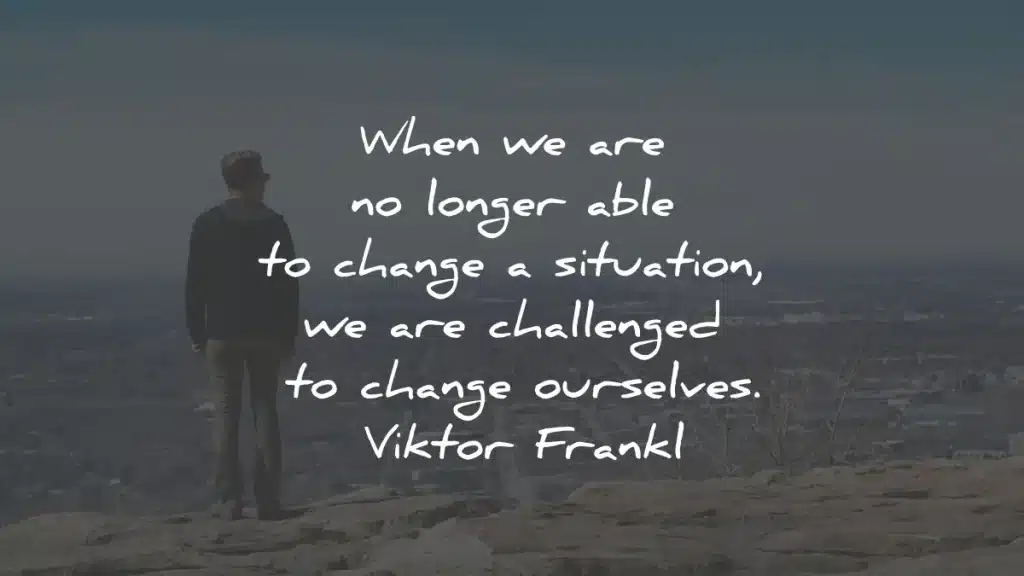
“When we are no longer able to change a situation, we are challenged to change ourselves.”
“The meaning of life is to give life meaning.”
“What is to give light must endure burning.”
“In some ways, suffering ceases to be suffering at the moment it finds a meaning.”
“Life is never made unbearable by circumstances, but only by lack of meaning and purpose.”
“Ultimately, man should not ask what the meaning of his life is, but rather he must recognize that it is he who is asked.”
“Live as if you were living already for the second time and as if you had acted the first time as wrongly as you are about to act now!”
“Between stimulus and response, there is a space. In that space is our power to choose our response. In our response lies our growth and our freedom.”
“What is demanded of man is not, as some existential philosophers teach, to endure the meaninglessness of life, but rather to bear his incapacity to grasp its unconditional meaningfulness in rational terms.”
“Those who have a ‘why’ to live, can bear with almost any ‘how.'”
“We who lived in concentration camps can remember the men who walked through the huts comforting others, giving away their last piece of bread. They may have been few in number, but they offer sufficient proof that everything can be taken from a man but one thing: the last of the human freedoms—to choose one’s attitude in any given set of circumstances, to choose one’s own way.”
“For the world is in a bad state, but everything will become still worse unless each of us does his best.”
“The attempt to develop a sense of humor and to see things in a humorous light is some kind of a trick learned while mastering the art of living.”
“A man who becomes conscious of the responsibility he bears toward a human being who affectionately waits for him, or to an unfinished work, will never be able to throw away his life. He knows the ‘why’ for his existence, and will be able to bear almost any ‘how’.”
“The truth—that love is the ultimate and the highest goal to which man can aspire. Then I grasped the meaning of the greatest secret that human poetry and human thought and belief have to impart: The salvation of man is through love and in love.”
“Don’t aim at success—the more you aim at it and make it a target, the more you are going to miss it. For success, like happiness, cannot be pursued; it must ensue, and it only does so as the unintended side effect of one’s personal dedication to a cause greater than oneself or as the by-product of one’s surrender to a person other than oneself.”
“In the final analysis, it becomes clear that the sort of person the prisoner became was the result of an inner decision, and not the result of camp influences alone.”
“The salvation of man is through love and in love.”
Reflecting on these quotes from “Man’s Search for Meaning” can be a transformative experience as we contemplate our own purpose and meaning in life. Viktor E. Frankl’s profound insights remind us that even in the face of adversity, we have the power to choose our attitude and find meaning in our experiences. Let these quotes serve as a guiding light on your own journey of self-discovery and purpose.






