
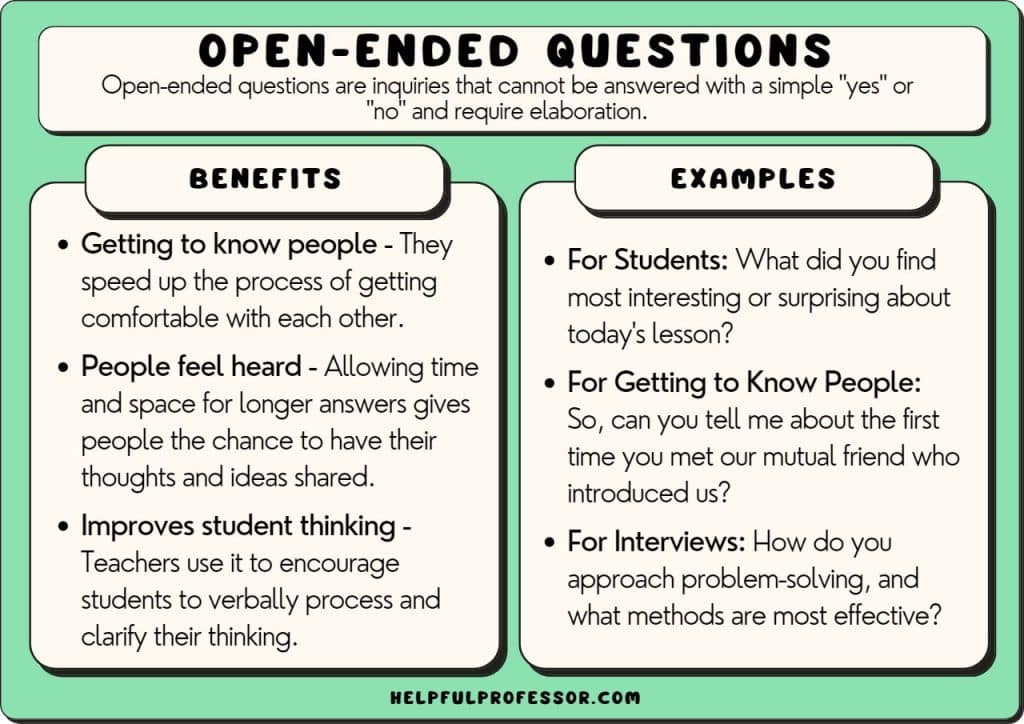
Asking open ended questions is a powerful technique used in the field of science to stimulate critical thinking and encourage deeper exploration of a topic. Unlike closed-ended questions that can be answered with a simple “yes” or “no,” open ended questions require more thoughtful and detailed responses. They promote active engagement, creativity, and a deeper understanding of scientific concepts. In this article, we will explore the importance of science open ended questions and provide a list of thought-provoking examples.
Science open ended questions play a crucial role in the scientific inquiry process. They allow scientists to gather information, form hypotheses, and analyze data in order to draw meaningful conclusions. By encouraging students or researchers to think critically and provide detailed explanations, open ended questions foster a deeper understanding of scientific principles. They also promote curiosity and creativity, as individuals are prompted to think outside the box and explore various perspectives and possibilities.
Furthermore, open ended questions help develop important skills such as problem-solving, communication, and critical thinking. Through the process of answering these questions, individuals are challenged to analyze information, evaluate evidence, and construct logical arguments. These skills are not only essential for scientific research but also have practical applications in everyday life.
See these science open ended questions:
- How does temperature affect the rate of plant growth?
- What are the potential impacts of climate change on marine ecosystems?
- How does gravity influence the formation of galaxies?
- What factors contribute to the diversity of species in a particular ecosystem?
- What are the long-term effects of deforestation on local wildlife populations?
- How does the pH level of soil affect the growth of different crops?
- What are the ethical implications of genetic engineering in humans?
- How does the presence of pollutants in water affect aquatic organisms?
- What are the potential benefits and risks of using nanotechnology in medicine?
- How does the process of photosynthesis contribute to the Earth’s oxygen levels?
- What are the factors that contribute to the formation of tornadoes?
- How does the Earth’s magnetic field protect us from solar radiation?
- What are the potential long-term effects of exposure to radiation?
- How does the human brain process and store memories?
- What are the factors that determine the effectiveness of a vaccine?
- How does the process of natural selection drive evolution?
- What are the potential benefits and risks of using renewable energy sources?
- How does the structure of DNA determine an organism’s traits?
- What are the factors that contribute to the occurrence of earthquakes?
- How does the human body maintain homeostasis?
- What are the potential impacts of plastic pollution on marine life?
- How does the process of cellular respiration produce energy for cells?
- What are the factors that influence the behavior of migratory birds?
- How does the human immune system defend against pathogens?
- What are the potential applications of artificial intelligence in healthcare?
- How does the process of plate tectonics shape the Earth’s surface?
- What are the factors that contribute to the formation of hurricanes?
- How does the human eye perceive color?
- What are the potential effects of climate change on global food security?
- How does the process of mitosis contribute to the growth and development of organisms?
- What are the factors that determine the efficiency of solar panels?
- How does the process of cellular division lead to the development of cancer?
- What are the potential risks and benefits of using genetically modified organisms in agriculture?
- How does the process of osmosis regulate water balance in plant cells?
- What are the factors that influence the speed of chemical reactions?
- How does the human respiratory system adapt to high altitudes?
- What are the potential impacts of antibiotic resistance on public health?
- How does the process of meiosis contribute to genetic variation?
- What are the factors that contribute to the formation of rainbows?
- How does the human circulatory system transport nutrients and oxygen throughout the body?
- What are the potential applications of stem cell research in regenerative medicine?
- How does the process of fermentation contribute to the production of alcoholic beverages?
- What are the factors that determine the strength of an electric current?
- How does the human digestive system break down and absorb nutrients?
- What are the potential impacts of air pollution on human health?
These science open ended questions serve as a starting point for further exploration and inquiry. They encourage individuals to think critically, analyze information, and develop a deeper understanding of scientific concepts. By incorporating open ended questions into science education and research, we can foster a culture of curiosity, creativity, and innovation.






