
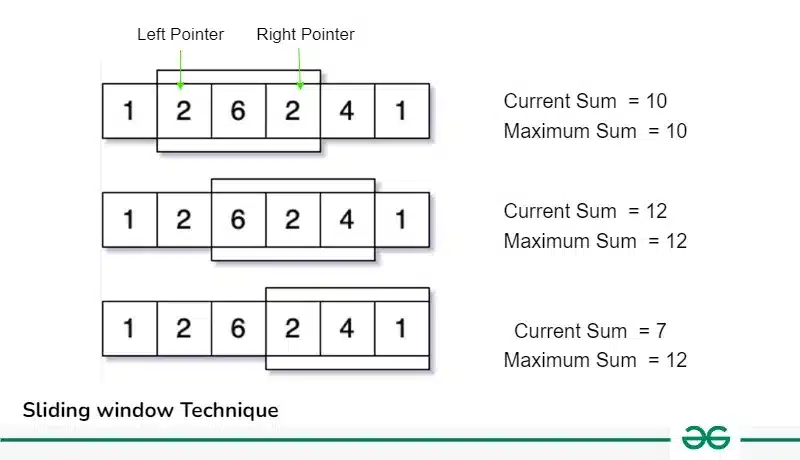
Sliding window questions are a type of algorithmic problem that involves maintaining a dynamic window or subarray within a larger array or string. The window slides through the array or string, continuously updating its contents based on certain conditions or constraints. This technique is particularly useful when the problem involves finding the maximum or minimum value within a subarray or string of fixed length.
The sliding window technique is a popular approach to solving problems efficiently, as it reduces the problem’s time complexity from O(n^2) to O(n). By maintaining a window of fixed size and moving it through the array or string, we can keep track of the current subarray or substring without redundant computations.
Sliding window questions are commonly encountered in coding interviews and competitive programming competitions. They test your ability to think creatively and efficiently while manipulating arrays or strings. Mastering this technique can greatly improve your problem-solving skills and help you tackle a wide range of algorithmic problems.
See these sliding window questions
- Maximum Sum Subarray of Size K
- Longest Substring Without Repeating Characters
- Smallest Subarray with a Given Sum
- Longest Repeating Character Replacement
- Longest Subarray with Ones after Replacement
- Count Number of Nice Subarrays
- Longest Turbulent Subarray
- Maximum Points You Can Obtain from Cards
- Minimum Size Subarray Sum
- Longest Continuous Increasing Subsequence
- Consecutive Characters
- Find All Anagrams in a String
- Max Consecutive Ones III
- Replace the Substring for Balanced String
- Maximize Distance to Closest Person
- Maximum Erasure Value
- Longest Substring with At Most Two Distinct Characters
- Max Consecutive Ones II
- Minimum Operations to Reduce X to Zero
- Count Substrings with Only One Distinct Letter
- Longest Substring with At Least K Repeating Characters
- Max Consecutive Ones
- Permutation in String
- Max Consecutive Ones in Binary Matrix
- Minimize Deviation in Array
- Minimum Window Subsequence
- Minimum Number of K Consecutive Bit Flips
- Longest Continuous Subarray With Absolute Diff Less Than or Equal to Limit
- Number of Subarrays with Bounded Maximum
- Maximum Number of Ones
- Maximize Palindrome Length From Subsequences
- Maximize Score After N Operations
- Number of Subarrays with Odd Sum
- Minimum Adjacent Swaps to Reach the Kth Smallest Number
- Number of Substrings Containing All Three Characters
- Longest Substring with At Most K Distinct Characters
- Maximize Grid Happiness
- Minimum Deletion Cost to Avoid Repeating Letters
- Get Equal Substrings Within Budget
- Maximum Sum of 3 Non-Overlapping Subarrays
- Maximize Score
- Maximize Distance Between Two Occurrences of the Same Element
- Maximum Length of Subarray With Positive Product
- Longest Substring Without Repeating Characters II
These are just a few examples of sliding window questions. Each problem has its own unique requirements and constraints, but the sliding window technique can be applied to efficiently solve them. By practicing these types of problems, you can sharpen your algorithmic thinking and become more proficient in solving coding challenges.






