
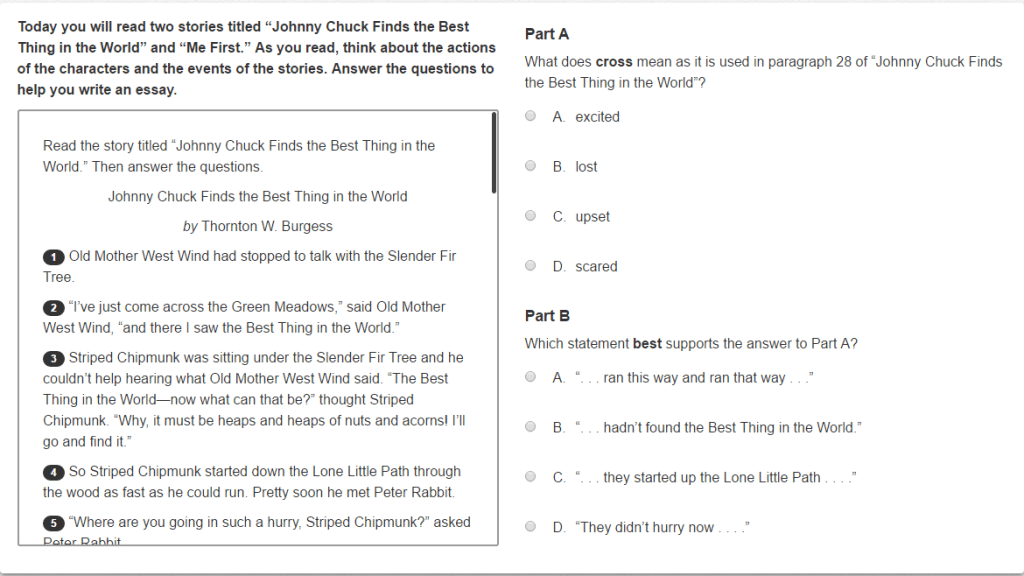
Standardized testing has become an integral part of the education system worldwide. These tests are designed to evaluate students’ knowledge, skills, and abilities in various subjects. As a result, standardized testing questions play a crucial role in determining students’ academic performance and future prospects. In this article, we will explore the importance of standardized testing questions and provide a comprehensive list of questions that students may encounter during these exams.
Standardized testing questions are carefully crafted to assess students’ understanding of specific subjects and their ability to apply knowledge to real-life scenarios. These questions are typically developed by educational experts and are standardized in terms of difficulty level, format, and scoring criteria. By using standardized testing questions, educators can ensure that all students are evaluated fairly and objectively.
Moreover, standardized testing questions provide valuable insights into students’ strengths and weaknesses, helping educators identify areas that require further attention and improvement. These questions also serve as a benchmark for comparing students’ performance with their peers, schools, and districts. Additionally, standardized testing questions enable educational policymakers to evaluate the effectiveness of curriculum, teaching methods, and overall academic standards.
See these standardized testing questions:
- What is the capital of France?
- Who wrote the novel “To Kill a Mockingbird”?
- Solve the equation: 2x + 5 = 15
- What is the chemical formula for water?
- Identify the main character in Shakespeare’s play “Hamlet.”
- Calculate the area of a triangle with a base of 8 cm and a height of 10 cm.
- Which planet is known as the “Red Planet”?
- What is the formula for calculating the volume of a cylinder?
- Who discovered the theory of relativity?
- What is the largest organ in the human body?
- What is the square root of 144?
- What is the chemical symbol for gold?
- Who painted the famous artwork “The Mona Lisa”?
- Which country is known as the “Land of the Rising Sun”?
- What is the formula for converting Fahrenheit to Celsius?
- What is the capital of Australia?
- Who is credited with inventing the telephone?
- What is the atomic number of carbon?
- What is the square root of 49?
- Which composer wrote the symphony “Symphony No. 9”?
- What is the formula for calculating the area of a circle?
- Who is the author of the Harry Potter series?
- What is the largest planet in our solar system?
- What is the formula for calculating density?
- Who wrote the play “Romeo and Juliet”?
- What is the capital of Spain?
- Who is the current President of the United States?
- What is the atomic number of oxygen?
- What is the formula for calculating velocity?
- Who is the author of “Pride and Prejudice”?
- Which country is known as the “Land of the Midnight Sun”?
- What is the formula for converting Celsius to Fahrenheit?
- What is the capital of Brazil?
- Who is the inventor of the electric light bulb?
- What is the atomic number of hydrogen?
- What is the square root of 81?
- Who composed the famous symphony “Symphony No. 5”?
- What is the formula for calculating the circumference of a circle?
- Who is the author of “The Great Gatsby”?
- What is the smallest planet in our solar system?
- What is the formula for calculating acceleration?
- Who wrote the play “Macbeth”?
- What is the capital of Italy?
- Who is the current Prime Minister of the United Kingdom?
- What is the atomic number of helium?
These are just a few examples of the types of questions students may encounter during standardized testing. It is important for students to familiarize themselves with the format and content of these questions to ensure they are well-prepared for their exams. By practicing with similar questions, students can improve their test-taking skills and increase their chances of achieving favorable results.
In conclusion, standardized testing questions play a significant role in evaluating students’ academic performance and providing valuable insights into their knowledge and abilities. By understanding the importance of these questions and actively preparing for them, students can enhance their overall educational experience and pave the way for future success.






