
Stephen Jay Gould was a renowned American paleontologist, evolutionary biologist, and historian of science. He was known for his ability to communicate complex scientific concepts in a clear and accessible manner. Throughout his career, Gould wrote numerous books and articles that challenged conventional wisdom and offered fresh insights into the natural world. His quotes continue to inspire and provoke thought, serving as a reminder of the importance of scientific inquiry and critical thinking.
One of Gould’s most famous quotes is, “The most erroneous stories are those we think we know best – and therefore never scrutinize or question.” This quote captures the essence of Gould’s approach to science and his belief in the need to constantly challenge our assumptions and preconceived notions. Gould was a strong advocate for questioning authority and seeking evidence-based explanations for natural phenomena.
Another notable quote by Gould is, “Science is not a heartless pursuit of objective information. It is a creative human activity, its geniuses acting more as artists than as information processors.” This quote highlights Gould’s view of science as a deeply human endeavor, one that requires creativity and imagination. He believed that scientists should not be limited to analyzing data but should also strive to make connections and tell compelling stories about the natural world.
Read these Stephen Jay Gould quotes
“We pass through this world but once. Few tragedies can be more extensive than the stunting of life, few injustices deeper than the denial of an opportunity to strive or even to hope, by a limit imposed from without, but falsely identified as lying within.”
“The most important scientific revolutions all include, as their only common feature, the dethronement of human arrogance from one pedestal after another of previous convictions about our centrality in the cosmos.”
“Facts do not ‘speak for themselves’; they are read in the light of theory. Creative thought, in science as much as in the arts, is the motor of changing opinion.”
“We are here because one odd group of fishes had a peculiar fin anatomy that could transform into legs for terrestrial creatures; because the earth never froze entirely during an ice age; because a small and tenuous species, arising in Africa a quarter of a million years ago, has managed, so far, to survive by hook and by crook. We may yearn for a ‘higher’ answer – but none exists.”
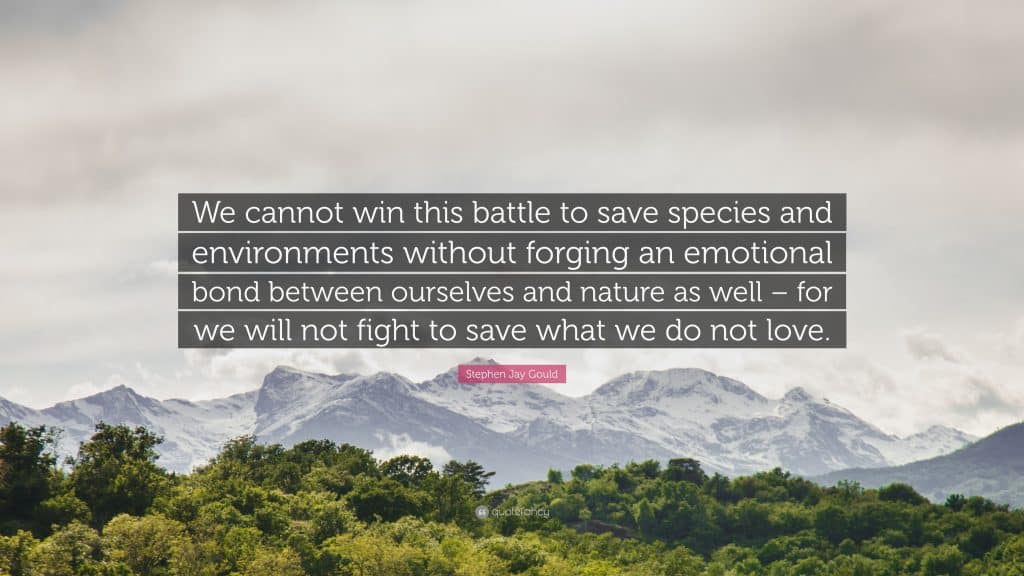
“We cannot win this battle to save species and environments without forging an emotional bond between ourselves and nature as well – for we will not fight to save what we do not love.”
“Human dignity is not derived from the ability to bear children, your honor, but from the ability to choose freely to do so or not to do so, as you think best.”
“The most important scientific revolutions all include, as their only common feature, the dethronement of human arrogance from one pedestal after another of previous convictions about our centrality in the cosmos.”
“I am, somehow, less interested in the weight and convolutions of Einstein’s brain than in the near certainty that people of equal talent have lived and died in cotton fields and sweatshops.”
“Science is not a heartless pursuit of objective information. It is a creative human activity, its geniuses acting more as artists than as information processors.”
“The most erroneous stories are those we think we know best – and therefore never scrutinize or question.”
“Creationist critics often charge that evolution cannot be tested, and therefore cannot be viewed as a properly scientific subject at all. This claim is rhetorical nonsense.”
“We are the offspring of history, and must establish our own paths in this most diverse and interesting of conceivable universes—one indifferent to our suffering, and therefore offering us maximal freedom to thrive, or to fail, in our own chosen way.”
“The world is not just the way it is. It is how we understand it, no? And in understanding something, we bring something to it, no? Doesn’t that make life a story?”
“The absence of evidence is not the evidence of absence.”
“We are the lucky






