
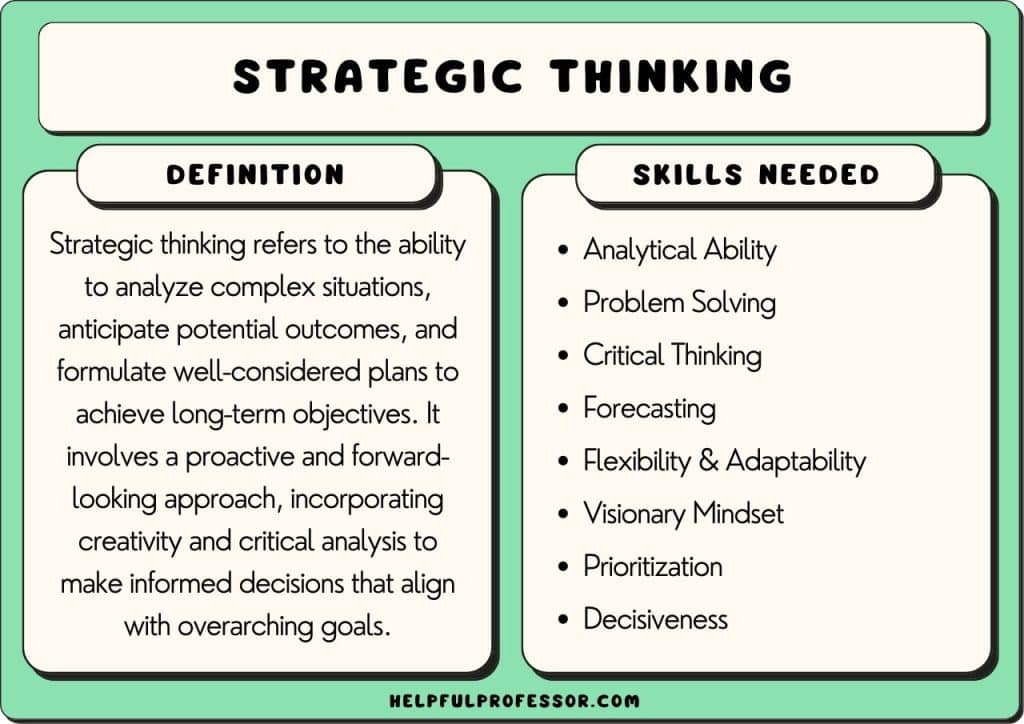
Strategic thinking is a crucial skill that enables individuals and organizations to make informed decisions, anticipate future challenges, and create effective plans to achieve long-term goals. Assessing strategic thinking abilities is necessary to identify strengths and areas for improvement, which can ultimately lead to enhanced performance and success. In this article, we will explore some strategic thinking assessment questions and provide answers to help you gain a better understanding of this valuable skill.
See these strategic thinking assessment questions and answers
- What is the definition of strategic thinking?
- How does strategic thinking differ from tactical thinking?
- What are the key components of strategic thinking?
- Why is strategic thinking important in business?
- How can strategic thinking be developed?
- What are some common challenges in strategic thinking?
- How can strategic thinking be applied in daily life?
- What are some strategic thinking tools and techniques?
- How can strategic thinking enhance leadership skills?
- What are the benefits of strategic thinking in team collaboration?
- How can strategic thinking be used to manage risks?
- What are some examples of strategic thinking in action?
- How does strategic thinking contribute to organizational success?
- What are the potential pitfalls of strategic thinking?
- How can strategic thinking be integrated into strategic planning?
Strategic thinking refers to the ability to analyze complex situations, identify patterns and trends, and make sound decisions that align with long-term objectives.
While tactical thinking focuses on short-term actions and immediate problem-solving, strategic thinking takes a broader perspective, considering the long-term implications and consequences of decisions.
Strategic thinking involves critical analysis, creative problem-solving, adaptability, forward-thinking, and the ability to anticipate and manage risks.
Strategic thinking enables businesses to stay ahead of competitors, identify new opportunities, adapt to changing market conditions, and make informed decisions that drive long-term growth and success.
Strategic thinking can be developed through practice, continuous learning, seeking diverse perspectives, analyzing case studies, and engaging in strategic planning exercises.
Common challenges in strategic thinking include biases, tunnel vision, resistance to change, limited data, and the inability to see the bigger picture.
Strategic thinking can be applied in daily life by setting goals, analyzing options, making informed decisions, managing time effectively, and prioritizing tasks based on long-term objectives.
Some strategic thinking tools and techniques include SWOT analysis, scenario planning, critical thinking exercises, mind mapping, and the use of decision-making frameworks.
Strategic thinking enhances leadership skills by enabling leaders to see the bigger picture, anticipate challenges, inspire innovation, make informed decisions, and effectively communicate and execute long-term plans.
Strategic thinking in team collaboration fosters a shared vision, encourages creative problem-solving, improves decision-making, enhances communication, and promotes synergy among team members.
Strategic thinking helps in managing risks by identifying potential threats, assessing their impact, developing contingency plans, and continuously monitoring and adapting strategies to mitigate risks.
Examples of strategic thinking in action include developing a long-term business growth plan, conducting market research to identify new opportunities, and creating a crisis management strategy.
Strategic thinking contributes to organizational success by driving innovation, improving decision-making, fostering agility, enhancing competitiveness, and ensuring alignment between short-term actions and long-term goals.
Some potential pitfalls of strategic thinking include overanalyzing, lack of flexibility, ignoring short-term needs, disregarding stakeholder perspectives, and failing to execute plans effectively.
Strategic thinking can be integrated into strategic planning by involving key stakeholders, conducting thorough analysis, setting clear objectives, developing action plans, and continuously evaluating and adjusting strategies based on new information and market dynamics.
This list of strategic thinking assessment questions and answers provides a glimpse into the various aspects and applications of this critical skill. By understanding the fundamentals of strategic thinking and evaluating your own abilities in this area, you can develop strategies and approaches that lead to improved decision-making and long-term success in both personal and professional contexts.






