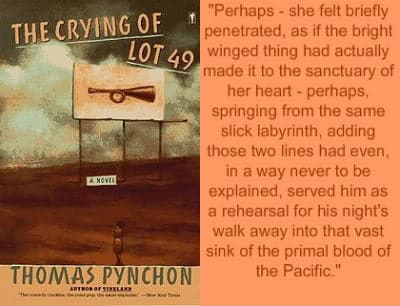
“The Crying of Lot 49” is a novel written by Thomas Pynchon in 1966. This postmodern masterpiece explores themes of conspiracy, paranoia, and the search for meaning in a chaotic world. Throughout the book, Pynchon offers readers a multitude of thought-provoking quotes that delve into the existential dilemmas faced by the protagonist, Oedipa Maas. In this article, we have compiled a list of 20 compelling quotes from “The Crying of Lot 49” that will surely captivate and intrigue you.
Read these “The Crying of Lot 49” quotes:
Read these “The Crying of Lot 49” quotes
“She thought of the way he’d run his hands, not skipping a page, all the way through the Book of Bokonon, as if it were a sacred text, and of how she herself, a stranger to such piety, would probably never open another novel again without a little pang of dread at discovering there, on the flyleaf, this code she didn’t know.”
“It is a curve each of them feels, unmistakably. It is the parabola. They must have guessed, once or twice – guessed and refused to believe – that everything, always, collectively, had been moving toward that purified shape latent in the sky, that shape of no surprise, no second chance, no return.”
“The street was silent. The ceiling of the room showed a few cracks, irregular, like branches or veins. Oedipa wondered whether, at the end of this (if it were supposed to end), she too might not be left with only compiled memories of clues, announcements, intimations, but never the central truth itself, which must somehow each time be too bright for her memory to hold.”
“The scope of the conspiracy drained her energy; it was about to become so enormous and fantastic it would leave her no room to breathe, much less to think. Or it was to become a conspiracy so small and trivial, so meaningless, she would run on pure stubbornness for the rest of her life, refusing to believe in the existence of anything less.”
“What was it that Oedipa Maas, late of Kinneret-Among-The-Pines and other places, had in her possession that might have some bearing on all this? Something she didn’t know she knew?”
“She looked across a room of people for somebody, anybody who might tell her if, maybe, she was going stark raving mad.”
“She’d stumbled on, through history, had fallen in with, and been used by, teachers of history, always the ones operated by powerful men, who sought to conceal themselves, behind the puppet-strings of symbols, of literary references, of racial hatreds masked as philosophies, movements once radical, now dead as the phlogiston theory, of old-time depressions, forgotten except as mazes of facts.”
“The girl she had been in Kinneret, in San Narciso, had she been any more than the thinnest of faces, a provisional character borrowed from a provisional book of fiction?”
“She went to the window to look out at the ocean. The fog had rolled in, and the waves were gray, and the beach, and the great boulders, and the palisades were gray, and the light, when she could see it, was gray. The fog seemed to have an eye, huge and unwinking, which she could not escape.”
“She thought she could see the sun, a dull red disk, letting down a weak light over the beach, the ocean, the boulders. She thought, I have to leave. I can’t leave. Maybe I’ll stay. The light was going.”
“Once upon a time, there were two brothers. Then there was only one: myself. I grew up fast, before learning not to. I helped my father, the poor immigrant, herd goats, which are stupid and have suicidal impulses in their blood, so that their market value will suddenly rise and fall unpredictably.”
“What sort of life would that be, thought Oedipa, to go back and back down that corridor between the living room and dining room, forever? Should she switch, try the other way? No, she knew what waits. Been there.”
“The evidence had a dream logic: the wrong dream. Or as Pynchon put it, not so long ago, in another context, ‘The true paranoid for whom all is organized in spheres joyful or threatening about the central pulse of himself, the core of ego throbbing in the center of the conscious mind, this paranoid, whose paranoia is the world, whose self is his only enemy, has no dreams.”
“It wasn’t a gesture of love or desire but of rage. The whole culture was this close to going up in flames.”
“It is one thing to suspect that one’s own world is illusion, another to hope to find some way of intersecting with one’s own world in a way that destroys it. Oedipa is tempted to do this, but she also knows that if she ever did find a way of destroying her own world, she would also destroy herself.”
“She felt herself, finally, more than ready to believe that it might not be the she and the others, the unembarrassed, ordinary, that were unreal, but this strange, nightmarish city of the paranoid, the grim, the uninvited.”
“Oedipa, perverse, had stood in front of the hotel mirror for an hour and practiced. Mirrors were her trip, her drug; mirrors put her in touch with madness. It made no difference how much she practiced, how authentic and articulate she might sound when, the time come, she actually accused him, she still believed in him, loved him.”
“She sat with her eyes closed, but the tears overflowed anyway, spilled down her cheeks. It was not sadness, though often at night she had felt her chest ripped open by a pain that actually seemed to hurt her heart, to squeeze it tight, and then every morning she thought she’d wake up and find it had either killed her or somehow been taken away.”
“Maybe the Tristero was only a conspiracy against silence. She fought back a wave of nausea and turned to the window, for air, for a look outside, but could see only her own reflection, fading against the glass. She wondered if she’d ever see the outside again. Or was the Tristero all there was?”
“The search for her own identity had led her to the repetition of other people’s thoughts. To the point where she herself, had she ever really been? Or had she been only a device, to generate the thoughts?”
“Oedipa wondered whether, at the end of this (if it were supposed to end), she too might not be left with only compiled memories of clues, announcements, intimations, but never the central truth itself, which must somehow each time be too bright for her memory to hold.”
These quotes from “The Crying of Lot 49” offer a glimpse into the intricate web of themes and emotions that Pynchon weaves throughout the novel. Whether it is the protagonist’s search for truth, her encounters with paranoia, or her contemplations on identity, these quotes reveal the depth and complexity of Pynchon’s storytelling. If you’re intrigued by these snippets, be sure to delve into the captivating world of “The Crying of Lot 49” and experience the full extent of Pynchon’s literary genius.