
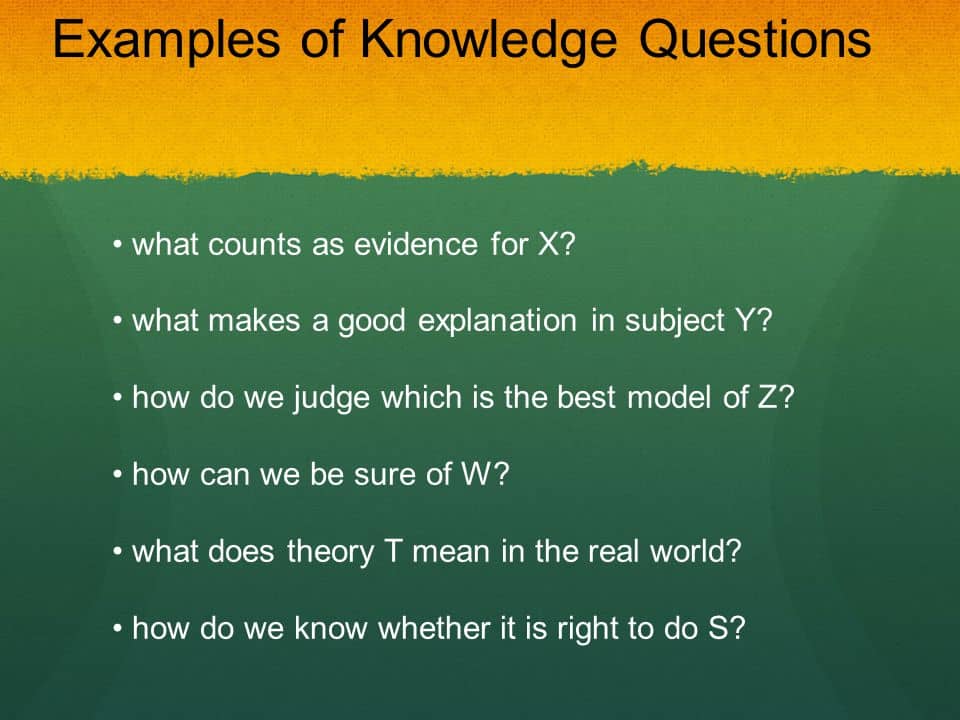
Tok (Theory of Knowledge) is a subject that is part of the International Baccalaureate (IB) Diploma Program. It is a unique course that aims to develop critical thinking skills and encourage students to question the nature of knowledge itself. Tok questions play a crucial role in this course as they serve as a starting point for exploration and analysis.
As part of the Tok course, students are required to explore different areas of knowledge and consider the ways in which knowledge is acquired, shared, and evaluated. These questions help to stimulate discussion and debate, allowing students to develop their own perspectives and understand the complexities of knowledge.
In this article, we will provide a list of Tok questions that can be used as a resource for students, educators, and anyone interested in exploring the nature of knowledge. These questions cover a wide range of topics and can be used to initiate thought-provoking discussions or serve as prompts for essays and presentations.
See these Tok questions
- What is the role of language in the acquisition of knowledge?
- How does emotion influence our perception of the world?
- Is knowledge subjective or objective?
- Can we have knowledge without evidence?
- What is the relationship between knowledge and power?
- How does culture shape our understanding of reality?
- What is the difference between belief and knowledge?
- How do we determine the reliability of sources of knowledge?
- Can knowledge be harmful?
- What is the role of intuition in the acquisition of knowledge?
- How does technology impact our understanding of the world?
- Can art be a form of knowledge?
- How does history shape our understanding of the present?
- What is the relationship between ethics and knowledge?
- Can knowledge be universal?
- What is the role of evidence in the pursuit of knowledge?
- How does personal bias influence the acquisition of knowledge?
- What is the impact of language barriers on the sharing of knowledge?
- Can knowledge be objective in the natural sciences?
- How does religion shape our understanding of the world?
- What is the role of reason in the acquisition of knowledge?
- How does memory affect our perception of the past?
- Can knowledge be gained through intuition alone?
- What is the relationship between perception and reality?
- How does the media influence our understanding of the world?
- What is the role of skepticism in the pursuit of knowledge?
- Can knowledge be gained through experience alone?
- How does gender affect our perception of knowledge?
- What is the impact of censorship on the sharing of knowledge?
- Can knowledge be gained through imagination?
- How does the scientific method contribute to the acquisition of knowledge?
- What is the relationship between intuition and reason in the pursuit of knowledge?
- How does personal experience shape our understanding of the world?
- Can knowledge be gained through faith alone?
- What is the role of intuition in the natural sciences?
- How does language shape our understanding of reality?
- What is the impact of technology on the reliability of knowledge?
- Can knowledge be gained through observation alone?
- How does culture impact the pursuit of knowledge?
- What is the relationship between intuition and perception?
- How does personal bias affect the evaluation of knowledge?
- Can knowledge be gained through reason alone?
- What is the role of evidence in the natural sciences?
- How does history influence the reliability of knowledge?
These are just a few examples of the many Tok questions that can be explored in the course. They serve as a starting point for discussions and reflections, allowing students to develop their own perspectives and engage in critical thinking. By questioning the nature of knowledge, students can gain a deeper understanding of the complexities of the world and their place in it.






